
Narcolepsy treatment
 Fact-checked by
Narcolepsy treatment usually involves a combination of medications and lifestyle changes to control symptoms and make it easier to go about daily life.
A rare sleep disorder, narcolepsy arises when the brain has trouble properly regulating sleep-wake cycles, so aspects of sleep intrude into waking hours. Common symptoms include excessive daytime sleepiness (EDS) — an overwhelming urge to sleep throughout the day — and cataplexy, or a sudden loss of muscle tone.
The appropriate treatment regimen, tailored to individual needs, can help ease these symptoms and allow people with narcolepsy to safely participate in daily activities like driving, swimming, or cooking.
Goals of narcolepsy treatment
There is no cure for narcolepsy, and most patients will still experience some degree of sleepiness even with treatment. The major goals of narcolepsy treatment are to:
- reduce daytime sleepiness and improve alertness
- minimize cataplexy
- improve nighttime sleep
By controlling these narcolepsy symptoms, people with the disease can more safely go about their daily activities and have an overall higher quality of life.
Treatment for narcolepsy is a highly individualized process, affected by factors such as age, lifestyle, symptoms, and co-existing medical conditions. Narcolepsy type 1 treatment focuses on controlling both EDS and cataplexy, while narcolepsy type 2 treatment is mainly focused on EDS and wakefulness because these patients don’t experience cataplexy.
Patients should work with a sleep specialist and other members of their care team to develop a tailored narcolepsy management plan that makes sense for them.
Medications for narcolepsy
Several medications have been approved in the U.S. for managing narcolepsy, and doctors may prescribe one or more of them depending on specific symptoms and other factors. Classes of approved narcolepsy medications include:
- wake-promoting agents
- oxybates
- traditional stimulants
Antidepressants, though not formally approved for narcolepsy, are sometimes used off-label to manage symptoms. In general, medications for narcolepsy are taken orally, one or more times per day.
Wake-promoting agents
Wake-promoting agents work by boosting the signaling of brain chemicals involved in wakefulness. They are commonly used as a first-line EDS treatment option, and are generally taken once a day in the morning. Those approved in the U.S. include:
Nuvigil and Provigil enhance a signaling chemical called dopamine, while Sunosi affects both dopamine and norepinephrine. All are approved to improve wakefulness in adults with narcolepsy-related EDS.
Wakix works somewhat differently from the other three medications by increasing the release of a wake-promoting molecule called histamine. It is approved for managing both EDS and cataplexy in narcolepsy patients 6 years and older.
Orzeyful
Orzeyful (oveporexton) works by mimicking the effects of a brain-signaling chemical called orexin in the body. It is approved to treat adults with type 1 narcolepsy. Orexin has wake-promoting actions and is missing in people with this form of narcolepsy.
The medication is taken daily as oral tablets.
Oxybates
Sodium oxybate medications are taken at night to suppress nervous system activity and improve the quality of overnight sleep. This indirectly helps ease daytime sleepiness and prevent cataplexy.
Three sodium oxybate formulations are approved in the U.S.:
- Lumryz (sodium oxybate)
- Xyrem (sodium oxybate)
- Xywav (calcium, magnesium, potassium, and sodium oxybates)
They all contain the same active ingredient and are approved for managing EDS and cataplexy in narcolepsy patients 7 years and older, but are formulated differently.
Xywav has less sodium than the other two medications, which can help lower cardiovascular risks. Lumryz is an extended-release formulation that allows once-nightly dosing, while the other two medications are administered twice a night.
Traditional stimulants
Before the emergence of more targeted therapies, traditional stimulant medications were commonly used for narcolepsy-related EDS. They work to boost dopamine and norepinephrine in the brain, but may carry more risks and side effects than newer wake-promoting agents.
Now, they are often used when other medications don’t work well enough, are not tolerated, or are not available. Stimulants for narcolepsy approved in the U.S. include:
- dextroamphetamine-amphetamine (formerly sold as Adderall, and now available only as generics)
- dextroamphetamine sulfate (sold as Dexedrine Spansule and generics)
- methylphenidate hydrochloride (sold as Methylin, Ritalin, and generics)
These medications are usually taken as oral tablets multiple times a day.
Antidepressants
Antidepressants, which affect brain signaling in various ways, are sometimes used off-label as a cataplexy treatment, but have no established guidelines for their use.
They may be considered when cataplexy is not controlled by newer treatments like oxybates.
Antidepressants that may be used to treat narcolepsy include:
- serotonin-norepinephrine reuptake inhibitors (e.g., Effexor)
- selective serotonin reuptake inhibitors (e.g., Prozac)
- tricyclic antidepressants (e.g., Anafranil)
Lifestyle strategies that support treatment
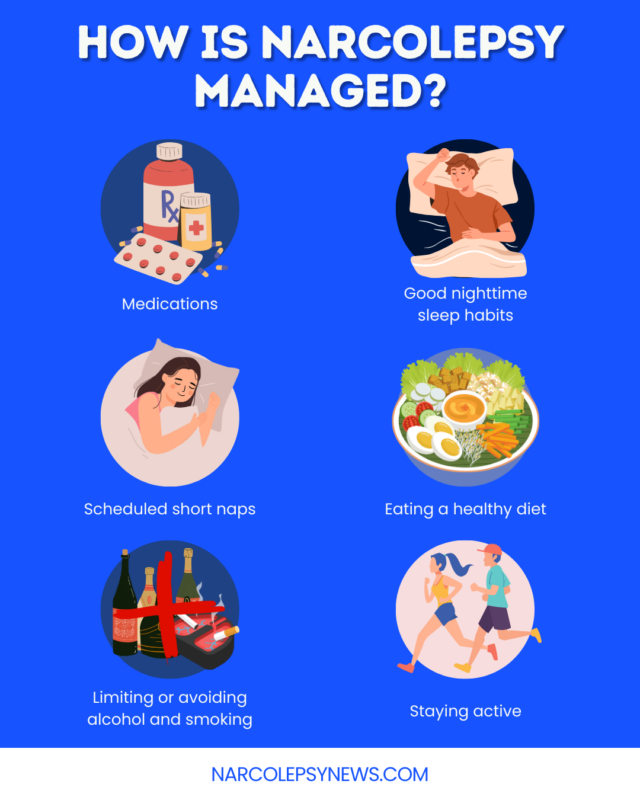
Along with medications, a doctor will likely recommend various lifestyle strategies for narcolepsy symptoms management. This might include:
- maintaining good sleep hygiene and a regular sleep schedule
- avoiding caffeine, alcohol, and large meals before bed
- quitting smoking
- taking regularly scheduled short naps to control sleepiness
- eating a healthy diet
- regularly exercising
These strategies can help improve nighttime sleep and ease daytime sleepiness, making living with narcolepsy easier.
What to expect after starting treatment
The effects of narcolepsy treatment might not be evident immediately. While some medications start working within days, others may take several weeks. A doctor will help you determine when driving with narcolepsy or resuming other daily activities is safe.
Early during treatment, side effects of narcolepsy medications may be substantial, but many of them subside over time as the body adjusts.
It’s important to regularly follow up with a sleep specialist and report any changes in symptoms and medication side effects. Adjustments to the treatment regimen may be needed over time.
Narcolepsy News is strictly a news and information website about the disease. It does not provide medical advice, diagnosis, or treatment. This content is not intended to be a substitute for professional medical advice, diagnosis, or treatment. Always seek the advice of your physician or other qualified health provider with any questions you may have regarding a medical condition. Never disregard professional medical advice or delay in seeking it because of something you have read on this website.