
What causes narcolepsy?
 Fact-checked by
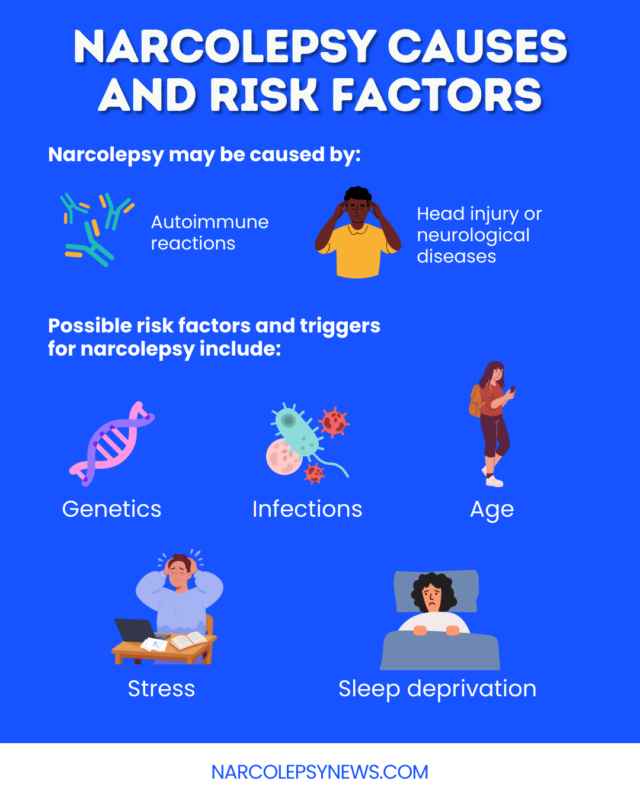
 While the exact narcolepsy causes are not fully established, the rare sleep disorder is generally believed to arise from autoimmune reactions that destroy wake-promoting nerve cells.
In people with narcolepsy, the brain cannot properly regulate sleep-wake cycles. Symptoms of narcolepsy include excessive daytime sleepiness, uncontrollable sleep attacks, and sudden loss of muscle tone (cataplexy).
Researchers do not fully understand why the immune system goes awry in narcolepsy, but various genetic and environmental risk factors may be involved. In rare cases, narcolepsy can also be triggered by head trauma or other forms of neurological damage.
Identifying the underlying cause is an important part of reaching a narcolepsy diagnosis. This helps doctors develop the most appropriate narcolepsy treatment strategy for each person.
How narcolepsy causes can differ
There are multiple possible causes of narcolepsy, which may partly depend on the type of the disease a person has. Two main types are recognized:
- Type 1: Characterized by very low levels of hypocretin (orexin), a brain signaling molecule that helps keep a person awake. Symptoms are generally more severe and include cataplexy.
- Type 2: Characterized by normal hypocretin levels. Symptoms are generally less severe and do not include cataplexy.
The current view is that autoimmune reactions are involved in both disease types, although this is best established for type 1 narcolepsy. Scientists are still working to understand exactly how type 2 narcolepsy develops. In either disease type, a range of genetic and environmental risk factors may also play a role.
In rare cases, narcolepsy can occur as a direct consequence of head trauma, tumors, or other brain injuries. This form is referred to as secondary narcolepsy.
The causes of narcolepsy in adults are generally the same as those seen in children.
Autoimmune issues
Narcolepsy type 1 is believed to be an autoimmune disease in which the immune system mistakenly attacks healthy hypocretin-producing nerve cells in the brain.
These cells play a critical role in regulating healthy sleep-wake cycles. Their near-complete loss in narcolepsy means the brain does not receive the signals it needs to suppress sleep and promote wakefulness at the appropriate times.
Scientists now believe that autoimmunity may also be involved in type 2 narcolepsy, although this has not been clearly established. It is possible that hypocretin nerve cells are not completely lost in this disease type but are instead damaged by immune activity and lose some of their function.
Genetic risk
Although narcolepsy is not directly inherited, genetic factors are believed to influence a person’s risk of developing the disease. If someone has a first-degree relative with type 1 narcolepsy, their chance of developing it is about 1%-2%.
Narcolepsy is strongly associated with a genetic variant called HLA-DQB1*06:02, which occurs in a gene involved in immune function. This variant is found in around 85%-95% of people with type 1 narcolepsy and around 40%-50% of those with type 2 narcolepsy.
However, HLA-DQB1*06:02 is also relatively common in the general population, and most people who carry it do not develop narcolepsy. This means the variant may increase susceptibility to the sleep disorder, but other risk factors and triggers are usually needed for narcolepsy to develop.
Several other immune-related genes have also been linked to narcolepsy, although their influence appears to be smaller. These genetic factors likely interact with environmental triggers to contribute to disease development.
Other potential causes and triggers
Because genetics alone do not appear to cause narcolepsy, scientists believe environmental factors may activate the immune system and trigger disease onset in genetically susceptible people. Possible triggers include:
- infections, particularly streptococcal infections (strep throat) and H1N1 influenza (swine flu)
- hormonal changes, including those that occur during puberty or menopause
- major psychological stress
- sleep deprivation
No vaccine routinely used in the U.S. has been linked to narcolepsy. An H1N1 vaccine that was previously marketed in parts of Europe was associated with a spike in narcolepsy cases but is no longer used.
Age is also among the narcolepsy risk factors. The disease most often develops between the ages of 10 and 30, although it can occur at any age.
In secondary narcolepsy, another condition or injury directly damages the hypothalamus, the region of the brain where hypocretin-producing neurons are located. Potential causes of secondary narcolepsy include:
- head trauma, such as traumatic brain injury or concussion
- brain tumors
- stroke
- inflammatory neurological diseases, such as multiple sclerosis
- brain inflammation (encephalitis)
In these cases, narcolepsy may develop even in people who don’t have a genetic predisposition.
Narcolepsy News is strictly a news and information website about the disease. It does not provide medical advice, diagnosis, or treatment. This content is not intended to be a substitute for professional medical advice, diagnosis, or treatment. Always seek the advice of your physician or other qualified health provider with any questions you may have regarding a medical condition. Never disregard professional medical advice or delay in seeking it because of something you have read on this website.