Wakix (pitolisant) for narcolepsy
 Fact-checked by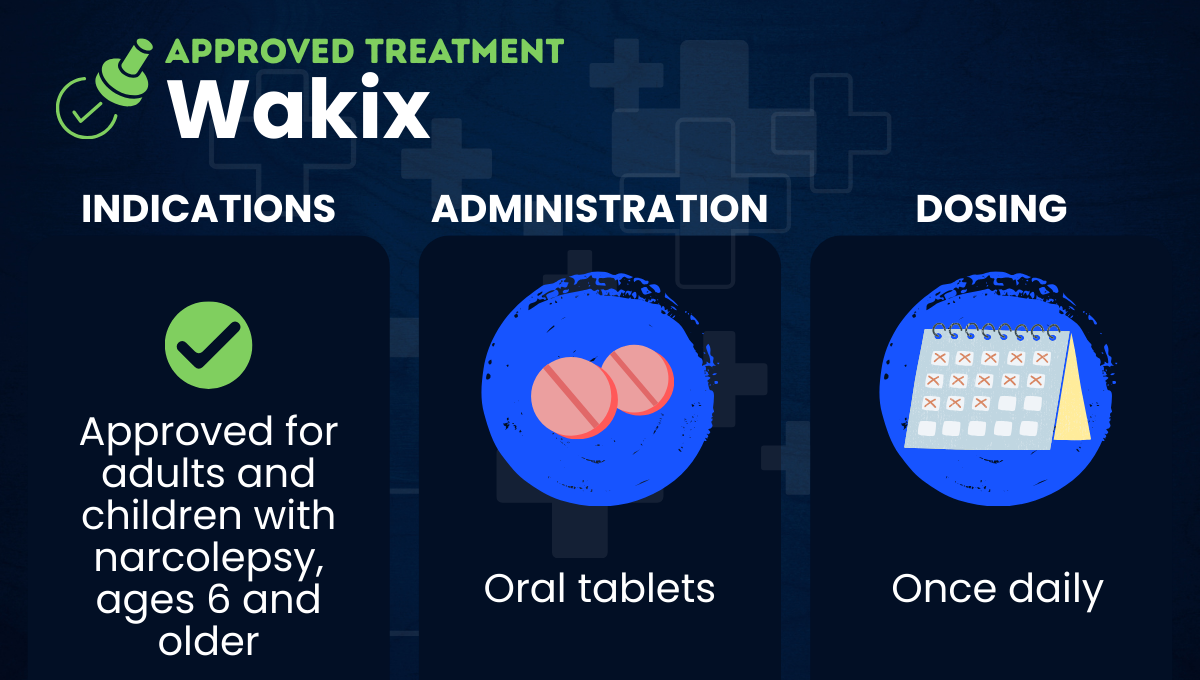
What is Wakix for narcolepsy?
Wakix (pitolisant) is an oral therapy approved to treat excessive daytime sleepiness (EDS) and cataplexy in adults and children with narcolepsy.
Narcolepsy is characterized by the brain’s inability to appropriately regulate sleep-wake cycles, leading to EDS, or an uncontrollable urge to sleep that occurs throughout the day. Many patients also experience episodes of cataplexy, or a sudden loss of muscle tone that reflects aspects of sleep intruding into daytime hours.
Wakix increases levels of histamine, a brain-signaling molecule that has powerful wake-promoting effects in brain areas that regulate sleep. This is thought to help stabilize sleep-wake transitions, easing daytime sleepiness and preventing cataplexy.
The medication is marketed in the U.S. by Harmony Biosciences, in the European Union by Bioproject Pharma, and in Canada by Paladin Labs, an Endo company.
Harmony is developing next-generation formulations of Wakix for treating narcolepsy. Among them are a gastro-resistant formulation designed to minimize gastrointestinal problems, and a high-dose formulation. Wakix formulations are also being evaluated for use in other conditions, such as Prader-Willi syndrome and idiopathic hypersomnia.
Therapy snapshot
| Brand name | Wakix |
| Chemical name | Pitolisant |
| Usage | Used to treat excessive daytime sleepiness or cataplexy in people with narcolepsy |
| Administration | Oral tablets |
Who can take Wakix?
In the U.S., Wakix is approved for the treatment of EDS or cataplexy in adults and children, ages 6 and older, with narcolepsy. It has similar approvals in the EU and Canada.
Wakix is contraindicated, or should not be used, by people with a history of immune reactions (hypersensitivity) to any ingredient in the medication, or people with severe liver impairment.
The medication is also not recommended for people with end-stage kidney disease.
How is Wakix administered?
Wakix comes as oral tablets to be taken once daily in the morning upon waking. The recommended dose is age-dependent:
- Adults: The starting dose is 8.9 mg for the first week, increased to 17.8 mg in the second week. Thereafter, the dose can be increased to a maximum of 35.6 mg as tolerated.
- Children: The starting dose is 4.45 mg for the first week, increased to 8.9 mg in the second week, and 17.8 mg in the third week, which is the maximum recommended dose for children weighing less than 40 kg (88 pounds). Thereafter, the dose can be increased to a maximum of 35.6 mg for children weighing at least 40 kg.
The dose may need to be adjusted for patients with liver or kidney impairment, for people with genetic traits that affect the enzyme needed to break down Wakix, or for people taking certain other medications.
Wakix in clinical trials
The approvals of Wakix for use by people with narcolepsy were largely supported by four placebo-controlled Phase 3 clinical trials:
- The Harmony1 study (NCT01067222), conducted in Switzerland, showed that Wakix led to significantly greater improvements than a placebo in a patient-reported measure of sleepiness among adults with narcolepsy. In participants with cataplexy, significantly greater reductions in the daily rate of cataplexy attacks were observed with Wakix compared with the placebo.
- A Phase 3 study (NCT01638403) conducted in France similarly demonstrated that Wakix led to significantly greater improvements in a patient-reported measure of sleepiness than a placebo.
- The HARMONY CTP trial (NCT01800045), based in Hungary, showed that Wakix was associated with significantly greater reductions in the mean number of cataplexy attacks compared with a placebo among adults with narcolepsy.
- A pediatric study (NCT02611687), conducted in Europe and Russia, demonstrated that Wakix led to significantly greater improvements on a patient-reported measure of EDS-related symptoms among children with narcolepsy, ages 6-17. In participants with cataplexy, significantly greater reductions in the average number of weekly cataplexy attacks were observed with Wakix.
Wakix side effects
The most common side effects of Wakix in adults include:
- insomnia
- nausea
- anxiety
The most common side effects of Wakix in children include:
- headache
- insomnia
Wakix also carries a warning that it can prolong the QT interval, in which the heart’s electrical system takes longer than normal to recharge between beats. The medication should be avoided in people with a known history of this problem or other heart rhythm abnormalities, or those who are using other medications that could cause QT prolongation.
Wakix may interact with other medications, so patients should always tell their healthcare providers about any other drugs they are taking. It could also reduce the effectiveness of hormonal contraceptives (e.g., birth control pills). A nonhormonal form of contraception (e.g., condoms) should be used during treatment with Wakix and for at least three weeks afterward.
Narcolepsy News is strictly a news and information website about the disease. It does not provide medical advice, diagnosis, or treatment. This content is not intended to be a substitute for professional medical advice, diagnosis, or treatment. Always seek the advice of your physician or other qualified health provider with any questions you may have regarding a medical condition. Never disregard professional medical advice or delay in seeking it because of something you have read on this website.