
Provigil (modafinil) for narcolepsy
 Fact-checked by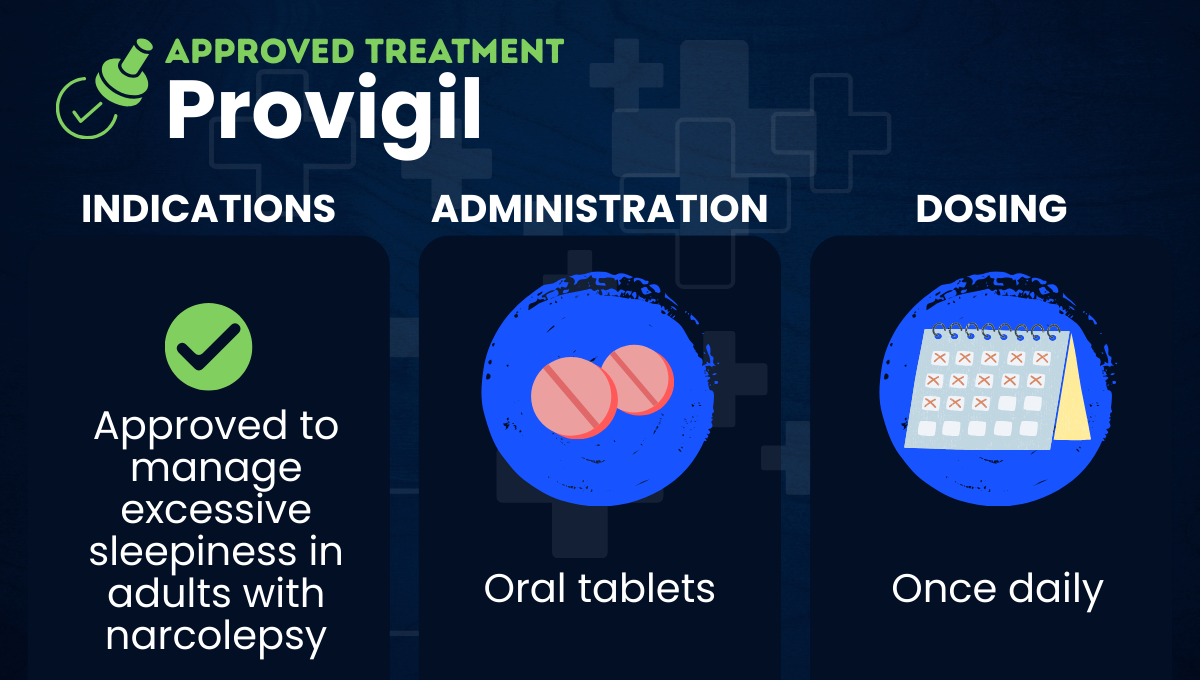
What is Provigil for narcolepsy?
Provigil (modafinil) is an approved oral therapy that’s used to improve wakefulness in adults with excessive sleepiness related to narcolepsy.
Narcolepsy is a neurological disorder in which the brain can’t properly regulate sleep-wake cycles. Its hallmark symptom is excessive daytime sleepiness, or an uncontrollable urge to sleep at any time of day.
Taken as oral tablets, Provigil increases the levels of the brain signaling molecule dopamine, which in turn boosts wake-promoting signals in parts of the brain that regulate sleep. While it also influences other chemicals involved in sleep regulation, the exact mechanisms aren’t totally understood. Altogether, these actions help a person stay awake and alert during the day.
Provigil is marketed in the U.S. by Apotex, where it is also approved for the treatment of sleepiness related to obstructive sleep apnea and shift work disorder. Generic versions of the medication are also available. The company also markets Nuvigil (armodafinil), which works similarly to Provigil for people with narcolepsy, but is designed to last longer in the body.
In Canada, Teva Canada markets the therapy under the brand name Alertec. Across Europe, it is marketed by Neuraxpharm and sold under various local brand names, including Vigil, Modasomil, or Modiodal.
Therapy snapshot
| Brand name | Provigil |
| Chemical name | Modafinil |
| Usage | Used to improve wakefulness in adults with narcolepsy |
| Administration | Oral tablets |
Who with narcolepsy can take Provigil?
In the U.S., Provigil is approved to improve wakefulness in adults with excessive sleepiness associated with narcolepsy. It holds similar approvals in Canada and Europe.
Provigil is contraindicated, or should not be used, by people with a history of immune reactions (hypersensitivity) to its main ingredient, any of its inactive ingredients, or the main ingredient in Nuvigil.
How is Provigil administered in narcolepsy?
Provigil comes in oral tablet form. The recommended dose is 200 mg, taken once a day in the morning. The dose may need to be reduced for older people or those with severe liver problems.
Provigil in narcolepsy clinical trials
The approval of Provigil for treating narcolepsy was supported by data from two clinical trials that collectively involved 558 adults with narcolepsy. Participants in either trial were randomly assigned to receive once-daily Provigil (200 or 400 mg) or a placebo for nine weeks.
- Data from the first study showed that either dose of Provigil was associated with significant reductions in both subjective and objective measures of sleepiness compared with the placebo.
- These findings were confirmed in the second study, in which Provigil was associated with significant reductions in sleepiness, again confirmed with both subjective and objective measures. A treatment discontinuation phase of that study showed that sleepiness returned to previous levels when Provigil was stopped, but there were no signs of physical withdrawal from the medication.
Nighttime sleep was not affected by Provigil use in these studies.
Provigil side effects
The most common side effects associated with Provigil include:
- headache
- nausea
- nervousness or anxiety
- stuffy or runny nose
- diarrhea
- back pain
- insomnia
- dizziness
- indigestion
Provigil also comes with warnings for less common, but potentially serious side effects:
- serious rashes, including Stevens-Johnson syndrome, a rare and life-threatening reaction
- swelling under the skin (angioedema) or anaphylaxis, a life-threatening systemic immune reaction
- multiorgan hypersensitivity reactions
- psychiatric problems, especially in people with a history of these issues
- cardiovascular problems in people with existing heart issues
Patients using Provigil will be routinely monitored for these complications. Should they occur, Provigil may need to be discontinued.
Provigil may interact with certain other medications, including hormonal contraceptives (i.e., birth control pills). Alternative or additional methods of contraception should be used while taking Provigil and for one month after stopping it.
Some people taking Provigil may continue to experience excessive sleepiness. Patients should work with their doctors to determine when it’s safe to resume potentially dangerous activities, such as driving.
Provigil may produce positive mood-altering effects, posing a risk of drug abuse, physical dependence, and overdose. Patients using the medication will be monitored for signs of abuse or misuse.
Narcolepsy News is strictly a news and information website about the disease. It does not provide medical advice, diagnosis, or treatment. This content is not intended to be a substitute for professional medical advice, diagnosis, or treatment. Always seek the advice of your physician or other qualified health provider with any questions you may have regarding a medical condition. Never disregard professional medical advice or delay in seeking it because of something you have read on this website.