
Narcolepsy diagnosis
 Fact-checked by
 Reaching a narcolepsy diagnosis involves careful symptom monitoring and diagnostic tests to understand how the brain regulates sleep-wake cycles.
Narcolepsy is a rare sleep disorder in which the brain can’t maintain the normal boundaries between sleep and wakefulness. There are a few possible narcolepsy causes, but they all result in excessive and uncontrollable sleepiness throughout the day, along with other symptoms.
To diagnose the disease, doctors must ensure that a person is truly experiencing recurrent, irresistible sleepiness and that no other explanation accounts for their symptoms.
Early signs of narcolepsy
Symptoms of narcolepsy can occur at any age, but most often appear in adolescence and young adulthood, between the ages of 10 and 30. In almost all cases, the first sign of the sleep disorder is excessive daytime sleepiness (EDS), or an uncontrollable urge to sleep at any time of day.
This may manifest as:
- sudden sleep attacks, or falling asleep even in the middle of daily activities
- children resuming naps they had previously outgrown or sleeping longer at night
- behavioral problems, such as hyperactivity, irritability, or memory and attention issues
Behavioral changes are common initial signs of narcolepsy in children and adolescents, who are often misdiagnosed with attention-deficit/hyperactivity disorder or a mood disorder. This can lead to substantial diagnostic delays.
Thus, while narcolepsy symptoms commonly appear in adolescence, the average age of narcolepsy diagnosis is in early adulthood.
For people with type 1 narcolepsy, another early sign of the disease may be cataplexy, a sudden loss of muscle tone that often happens with strong emotions. Initially, these symptoms may be mild, such as a slight drooping of the eyelid or momentary slackness of the jaw.
First steps toward a diagnosis
Various online self-assessment tools can help a person determine whether their sleep patterns are problematic. While digital tools offer insights, a formal narcolepsy diagnosis online cannot be established; it requires clinical evaluation and sleep studies.
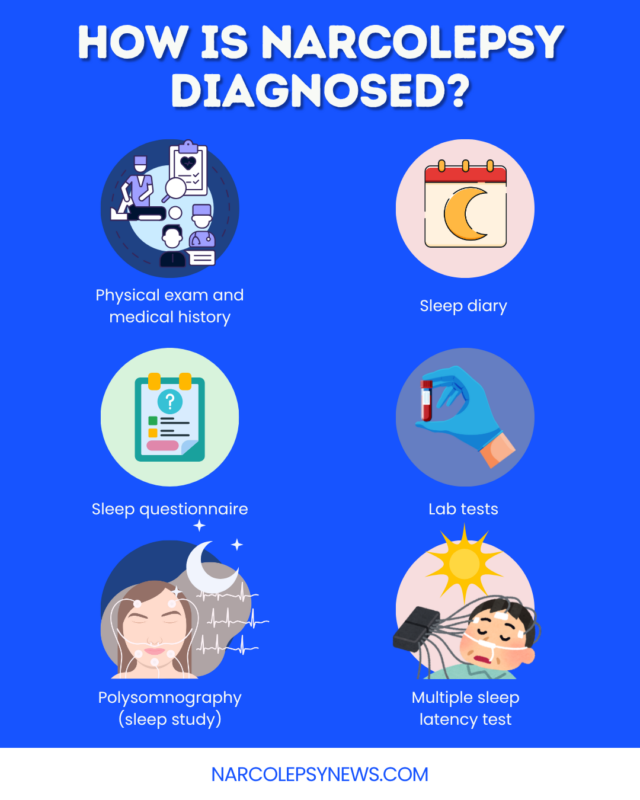
If a person suspects they have narcolepsy or another sleep disorder, they should reach out to a physician. The doctor will collect information about their family and medical history. To get more information, they may also ask patients to:
- keep a sleep diary that tracks sleep patterns and other symptoms for a couple of weeks
- wear a device that tracks their activity during the day and at night
- fill out a sleep questionnaire to assess the degree of sleepiness and daily life impacts
Doctors may also run blood tests to rule out common causes of sleepiness or fatigue, such as thyroid problems or vitamin deficiencies.
Key diagnostic tests
If early evaluations raise suspicion of narcolepsy, a person will likely be referred to a neurologist or other sleep medicine specialist for further testing if they haven’t already. Two key tests are needed for a narcolepsy diagnosis:
- Polysomnography (sleep study): Uses sensors to monitor brain activity, heart rate, breathing, and muscle movements during overnight sleep.
- Multiple sleep latency test (MSLT): Uses sensors to evaluate how long it takes to fall asleep during scheduled naps throughout the day.
The two narcolepsy tests are performed sequentially. First, a person will stay at a sleep clinic overnight for a polysomnogram. This test helps track how a person cycles through different sleep stages and can rule out other conditions that may cause daytime tiredness, such as sleep apnea.
The next day, the MSLT will be performed. An individual will be asked to take five scheduled naps throughout the day. They’ll be hooked up to sensors that measure how quickly they fall asleep and which sleep stage they enter.
Healthy sleep involves cycling through four stages, the last being rapid eye movement (REM) sleep. People with narcolepsy, however, tend to fall directly into REM soon after falling asleep, skipping other necessary stages.
In some cases, doctors might also test a sample of a person’s spinal fluid to check the levels of hypocretin, a brain signaling molecule that’s deficient in type 1 narcolepsy, the most common disease type.
Diagnostic criteria
According to the International Classification of Sleep Disorders, a narcolepsy diagnosis requires:
- chronic sleepiness: Daily EDS that has lasted for at least three months and can’t be explained by another sleep disorder, medical condition, or medication use.
- short sleep latency: A person must fall asleep, on average, in less than eight minutes during the MSLT.
- early REM sleep: A person must enter into the REM phase within 15 minutes of falling asleep during at least two of the MSLT naps, or one MSLT nap and the previous night’s polysomnography.
These narcolepsy diagnostic criteria also require the presence of cataplexy or low levels of hypocretin in the spinal fluid for a type 1 narcolepsy diagnosis.
Establishing a type 2 narcolepsy diagnosis is more challenging because hypocretin levels are usually normal. It largely relies on meeting the above criteria and ruling out a type 1 diagnosis.
Next steps after diagnosis
After a diagnosis of narcolepsy, patients will work with their care team to develop a tailored management plan. This may involve using approved narcolepsy treatments to help suppress sleep and promote wakefulness.
A doctor will likely also recommend making lifestyle adjustments to cope with sleepiness and minimize the impact of narcolepsy on daily life. This may include things like regularly scheduled naps, physical activity, and dietary changes.
Narcolepsy and its symptoms can evolve over time. As with any chronic disease, regular follow-up care and communication with the healthcare team are key to living well with narcolepsy.
Narcolepsy News is strictly a news and information website about the disease. It does not provide medical advice, diagnosis, or treatment. This content is not intended to be a substitute for professional medical advice, diagnosis, or treatment. Always seek the advice of your physician or other qualified health provider with any questions you may have regarding a medical condition. Never disregard professional medical advice or delay in seeking it because of something you have read on this website.