
How WSCN is redefining sleep health, and why we should pay attention
Written by |
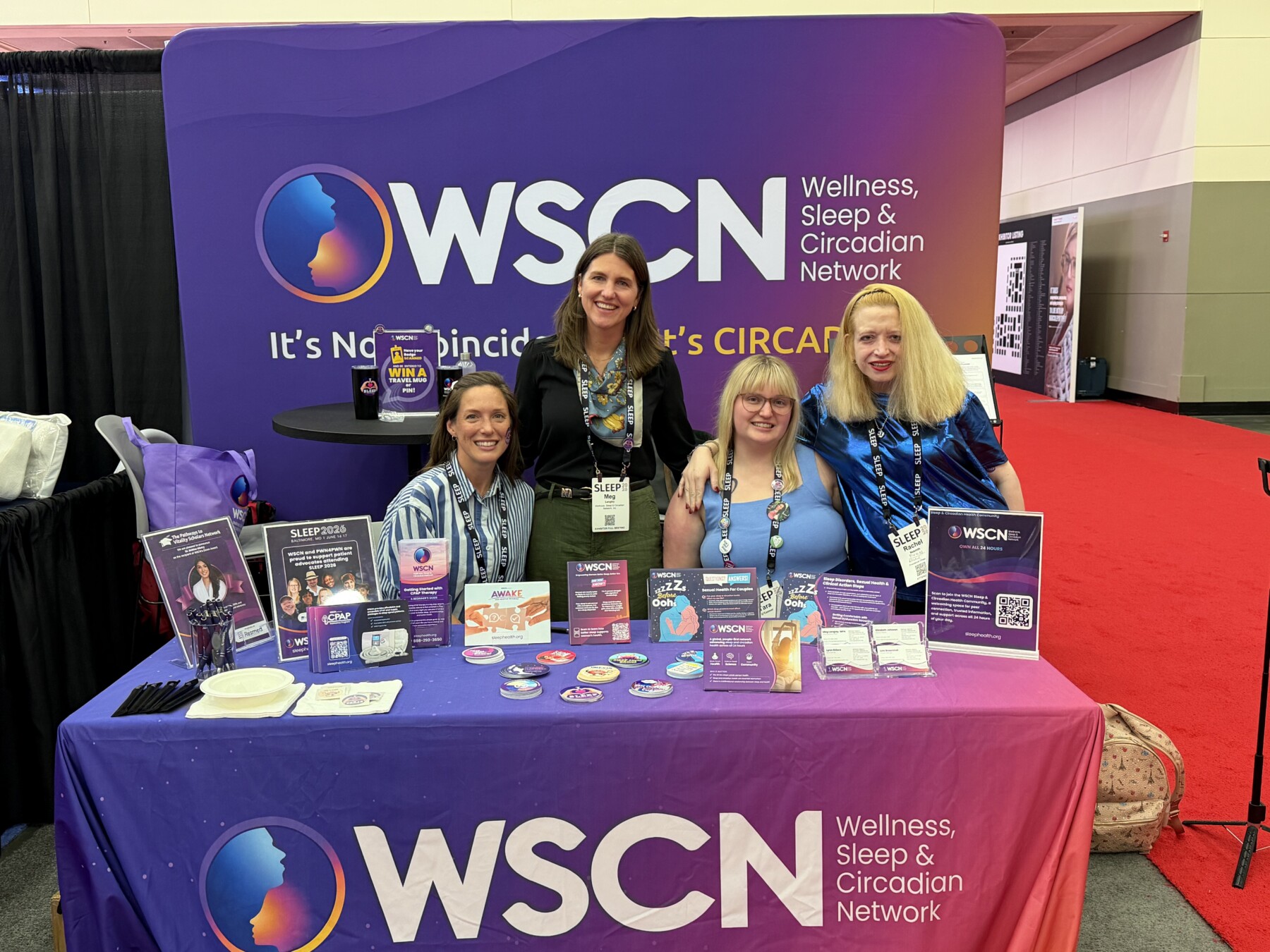
From left, Wellness, Sleep & Circadian Network Program Manager Lola Broomhall, Chief Operating Officer Meg Langley, and patient advocates Tara O’Connor and Rachel Nesmith work the WSCN booth at SLEEP 2026 last June in Baltimore. (Courtesy of Rachel Nesmith)

Note: Rachel Nesmith lives with narcolepsy and is a columnist for Narcolepsy News.
Last June, I volunteered for the Wellness, Sleep & Circadian Network (WSCN) at SLEEP 2026, a four-day event held in Baltimore. I had the pleasure of speaking with WSCN Chief Operating Officer Meg Langley and Program Manager Lola Broomhall about the nonprofit’s commitment to the sleep community.
For decades, sleep health was organized around individual diagnoses. Sleep apnea, narcolepsy, insomnia, restless legs syndrome, and circadian rhythm disorders each had their own research communities and advocacy efforts. While this disease-specific approach has been important, sleep medicine is now evolving.
Today, we understand that sleep disorders rarely exist in isolation. That shift is central to WSCN’s mission.
Formerly known as the American Sleep Apnea Association, which was founded in 1990, the WSCN expanded its mission in 2025 beyond sleep apnea to become a global knowledge hub addressing sleep, circadian science, wellness, and patient-centered research. Instead of focusing on a single condition, WSCN now promotes a “24-hour” view of health.
Under the leadership of board chair Anne Marie Morse, who also is my trailblazing sleep doctor, the WSCN is undergoing a powerful metamorphosis to incorporate sleep as an essential pillar of overall health. As someone living with narcolepsy with cataplexy, I find this perspective meaningful. Narcolepsy is often defined by excessive daytime sleepiness, but the reality is more complex. Many of us also experience fragmented nighttime sleep, mental health challenges, metabolic issues, autoimmune conditions, and chronic pain. A broader lens reflects what patients already know: Our health cannot be reduced to a single diagnosis.

Putting patients at the center
One of WSCN’s key initiatives is the AWAKE Peer Mentor Program, which connects individuals using positive airway pressure therapy with trained volunteers who have successfully managed similar treatment journeys. While currently focused on sleep apnea, its core idea applies across all sleep disorders. Peer support offers something clinical care often cannot: lived experience. Speaking with someone who truly understands can make a difficult diagnosis feel less isolating.
The narcolepsy community already understands this. Through support groups, conferences, and online spaces, peer connection transforms isolation into shared understanding.
Another initiative is the Patient Leadership in Research Program, which trains patients to become active collaborators in research. Participants learn how studies are designed and how to contribute patient perspectives throughout the process.
This represents an important shift. Too often, research is conducted about patients rather than with them. Yet patients are experts in lived experience. We know which symptoms matter most, where treatments fall short, and what questions still need answers. When patients are included, research becomes more relevant and impactful.
Preparing for a brighter future
Broomhall shared with me an ambitious vision for the future of sleep and circadian research in a follow-up interview in July. She emphasized that epidemiological studies should extend beyond traditional sleep disorders to include broader health areas such as oncology, women’s health, and menopause. She also highlighted the importance of studying sleep quality, health equity, public policy, the everyday impacts of sleep, and gaps in access to care. She stressed that children, in particular, need stronger education about healthy sleep habits to build lifelong wellness.
Her perspective reflects a key truth: Sleep and circadian rhythms affect nearly every system in the body.
Education is another cornerstone of WSCN’s mission. The organization is focused on translating complex sleep science into accessible information for patients, caregivers, clinicians, and the public in general. For those of us with narcolepsy, education is one of the most powerful tools we have.
Misunderstandings about narcolepsy remain widespread. Many still think it simply means being tired. Others are unaware of cataplexy, sleep paralysis, or hypnagogic hallucinations. Improving public understanding reduces stigma, shortens diagnostic delays, and builds empathy.
Langley shared her excitement about WSCN’s rebranding and redesigned website, calling it the start of a new chapter. She highlighted upcoming initiatives, including recognition awards honoring patients and caregivers for their contributions to the sleep health community.
She also encouraged patients to watch for new webinars, educational resources, and practical tools designed to support healthcare navigation. Future content will help patients prepare for appointments, communicate with physicians, understand treatment options, and advocate for their care. WSCN aims to provide trusted, evidence-based information that helps people understand how sleep affects the entire body across a full, 24-hour day.
That commitment to reliable education is critical in a landscape filled with misinformation. Patients need clear, science-based resources they can trust. WSCN emphasizes collaboration across disciplines, bringing together researchers, clinicians, healthcare systems, industry partners, and patient advocates. This model recognizes that no single group can address the complexity of sleep disorders alone.
For people living with narcolepsy, WSCN’s message resonates deeply. Sleep isn’t just a nighttime process — it shapes energy, cognition, safety, relationships, and health throughout every hour of the day. If organizations like WSCN continue to elevate patient voices, expand research boundaries, and translate science into action, the entire sleep and circadian health community will improve. And that’s a future worth staying awake for.
Note: Narcolepsy News is strictly a news and information website about the disease. It does not provide medical advice, diagnosis, or treatment. This content is not intended to be a substitute for professional medical advice, diagnosis, or treatment. Always seek the advice of your physician or another qualified health provider with any questions you may have regarding a medical condition. Never disregard professional medical advice or delay in seeking it because of something you have read on this website. The opinions expressed in this column are not those of Narcolepsy News or its parent company, Bionews, and are intended to spark discussion about issues pertaining to narcolepsy.
