
How Project Sleep honed my advocacy skills and helped me tell my story
This organization helped me find the words, confidence, and tools I needed
Written by |


Some organizations give you information. Some give you opportunities. And then there are organizations that help you discover your voice.
For me, Project Sleep has been one of those organizations.
In 2016, I became a second-generation Project Sleep Rising Voices advocate and trained speaker. That experience changed the way I told my story — and, in many ways, how I understood my responsibility as an advocate.
Before Rising Voices, I knew my own experience. I knew what it was like to live with narcolepsy, explain symptoms that other people couldn’t see, and navigate a world that often misunderstood sleep disorders. I had stories, frustrations, questions, and hard-earned wisdom. What I didn’t always have was the confidence or the structure to communicate those experiences in a way that could reach people beyond my immediate circle.
The Rising Voices training program helped change that.

Turning experiences into advocacy
I loved what Project Sleep President and CEO Julie Flygare was building. (I still do.) Julie has an incredible ability to make narcolepsy stories feel human, relatable, smart, and, delightfully, even a little bit elder millennial. She understands that behind every diagnosis is an actual person with a life, a personality, a family, dreams, frustrations, humor, and a story worth telling.
That perspective matters. Advocacy can sometimes become so focused on statistics, treatments, and medical terminology that the person living with the condition disappears. Project Sleep has consistently helped bring that person back into view.
And, yes, I was absolutely thrilled when Julie’s memoir, “Wide Awake and Dreaming,” was a prize I won as a Spirit Award during one of the Sleep In events. That book felt like more than a prize; it represented connection, recognition, and the joy of being part of a community that understood why these stories matter.
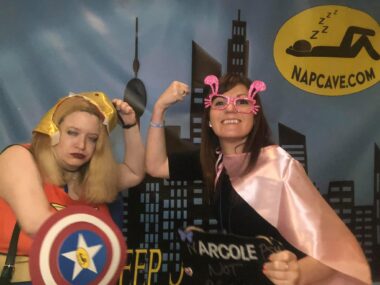
From left, columnist Rachel Nesmith and Project Sleep President and CEO Julie Flygare strike a pose in the “Nap Cave.” (Courtesy of Rachel Nesmith)
One of the greatest gifts Project Sleep gave me was something I still carry with me today: the ability to tell my story better.
The Rising Voices training taught me how to take my lived experience and turn it into storytelling that could educate, connect, and hopefully make someone else feel a little less alone. It taught me that sharing a personal story doesn’t mean revealing everything. It means choosing the details that help another person understand. It means finding the balance between honesty and purpose.
I’ve had the incredible honor of becoming a Rising Voices advocate and trained speaker twice: first for narcolepsy with cataplexy in the Class of 2016, and again for restless legs syndrome in 2026. Those experiences have reminded me that advocacy is not a single achievement; it is an ongoing practice. As our diagnoses, knowledge, communities, and audiences change, we continue learning how to speak with clarity and compassion.
I cannot talk about that journey without talking about my mentors.
Shannon Burkoth and Ello Oglesby were instrumental in my growth and success. I am incredibly grateful for the time, wisdom, encouragement, and belief they invested in me. Mentorship can be difficult to measure, but its impact is lasting. Sometimes a mentor offers a practical suggestion. Sometimes they ask a question that helps you see your own story differently. Sometimes they simply remind you that your voice belongs in the room.
What has always stood out to me about Project Sleep is the passion of the people behind the organization. You can feel how deeply they care about the sleep community and about helping people turn their experiences into meaningful advocacy. They recognize that education is important, but so are confidence, belonging, and hope.
Project Sleep didn’t give me a story. I already had one. They helped me find the words, confidence, and tools to tell it.
That voice has followed me everywhere since. From Rising Voices to Narcolepsy News, from advocacy campaigns to speaking opportunities, and from telling the funny stories to sharing the really hard ones, I continue to believe in the power of storytelling. Because sometimes changing the world doesn’t start with having all the answers. Sometimes it starts with simply having the courage to say, “This is what narcolepsy looks like for me.”
That sentence can open a conversation. It can challenge a stereotype. It can help a newly diagnosed person recognize themselves. It can remind a family member, clinician, employer, or friend that invisible doesn’t mean insignificant.
Thank you, Julie, Shannon, Ello, and everyone else at Project Sleep for helping so many of us find our voices. From one longtime sleepy advocate to another: Keep telling your story — somebody out there needs to hear it.
Note: Narcolepsy News is strictly a news and information website about the disease. It does not provide medical advice, diagnosis, or treatment. This content is not intended to be a substitute for professional medical advice, diagnosis, or treatment. Always seek the advice of your physician or another qualified health provider with any questions you may have regarding a medical condition. Never disregard professional medical advice or delay in seeking it because of something you have read on this website. The opinions expressed in this column are not those of Narcolepsy News or its parent company, Bionews, and are intended to spark discussion about issues pertaining to narcolepsy.


Leave a comment
Fill in the required fields to post. Your email address will not be published.