
Bridging the gap between clinical language and patient experiences
Advocate Solomon Briggs is showing others what narcolepsy actually looks like
Written by |


In my experience, the people I meet in the narcolepsy community often become more than friends. They become like family. They are fellow warriors, advocates, and truth-tellers who challenge me to see my disease a little differently.
Solomon Briggs, a brilliant friend and fellow advocate, is one of those people. Many in our community know him as “Narcoplexic,” the independent sleep advocate, writer, artist, photographer, and lifelong explorer of the lived experience of narcolepsy. Briggs has spent years asking questions that deserve far more attention, such as: What does narcolepsy actually look like from the inside? How variable can its symptoms be? And how much are we missing when we try to squeeze someone’s lived experience into a handful of clinical definitions?
At the recent SLEEP 2026 conference, Briggs took those questions to an extraordinary level by independently developing and presenting a phenomenal poster examining the many faces and presentations of cataplexy. The work, titled “Redefining Cataplexy: A Patient-Derived Visual Severity Scale and Linguistic Audit,” represents something I believe our community desperately needs: a broader vocabulary for describing what cataplexy can actually look and feel like.

Cataplexy isn’t always dramatic, like a person collapsing to the floor. Sometimes it can be a subtle physical drooping of the face, a head dropping, a jaw becoming difficult to control, or a hand suddenly losing strength. Or, it might be a person’s voice changing, their posture shifting, or their muscles experiencing sudden disruptions. On occasion, my eyes fight cataplexy paralysis, which causes my pupils to randomly move.
The experience can also be much more severe or turn into status cataplecticus, a rare manifestation of narcolepsy in which cataplexy episodes recur for hours or days.
Those of us who live with cataplexy know that it exists on a spectrum. Yet the public understanding of it is often remarkably narrow. Even within healthcare, the word can conjure one stereotypical image: someone laughing and suddenly falling down. That stereotype doesn’t tell the whole story. Briggs’ work challenges us to look beyond it.
What makes his contribution particularly meaningful to me is that he isn’t simply observing cataplexy from a distance. He is documenting something he has lived with for years. Briggs describes living with narcolepsy with complete cataplexy, and his advocacy has consistently focused on bringing lived experience into conversations that too often remain confined to clinical terminology.
The raw power of lived experience
This perspective matters. While patient-derived knowledge should not replace clinical research, it should complement it. Patients notice patterns. We develop language for experiences that may not have adequate words. We recognize nuances that can disappear when symptoms are reduced to checked boxes on a questionnaire. Briggs has made that kind of observation a central part of his advocacy.
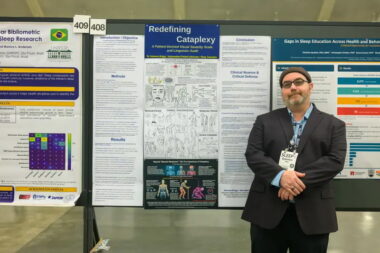
Solomon Briggs presents his poster, “Redefining Cataplexy: A Patient-Derived Visual Severity Scale and Linguistic Audit,” at the SLEEP 2026 conference in Baltimore, in June. (Courtesy of Alejandro Bruner-Solas and Solomon Briggs )
His Narcolepsy Symptom Severity Range Tool, for example, was created from years of personal experience, research, and advocacy. It seeks to communicate the variability and overlapping manifestations of narcolepsy symptoms. He has emphasized that such resources can potentially help patients communicate their experiences while also offering useful perspectives to clinicians and researchers.
That is the power of patient advocacy when it is done thoughtfully. It doesn’t simply say, “Listen to us.” It says, “Here is what we are experiencing. Here is the language we have developed to describe it. Now let’s build a better understanding together.”
As someone who has spent years advocating for people living with narcolepsy with cataplexy, I find Briggs’ work deeply inspiring. We need more patient advocates who are willing to investigate the uncomfortable spaces between textbook definitions and lived reality.
We also need researchers who are willing to listen. We need healthcare professionals who are willing to recognize that two people with the same diagnosis can experience profoundly different manifestations. And we need our community to stop measuring the legitimacy of someone’s cataplexy by how dramatic it looks from the outside.
Briggs is helping to open that conversation. His SLEEP 2026 poster wasn’t simply another presentation hanging among hundreds of scientific posters. To me, it represented something bigger: a patient standing in a scientific environment and declaring that there is more to this story.
There are more faces of cataplexy, degrees of severity, manifestations, experiences, and questions. Also, perhaps most importantly, there are millions of moments experienced by people with narcolepsy that still don’t have adequate words.
That is why I’m so proud to call Briggs my friend, fellow volunteer, and co-advocate. He is co-host of the Colorado Strong support group and isn’t just talking about changing the conversation. He’s helping build the vocabulary for it, and that is advocacy at its finest.
Sometimes changing narcolepsy awareness doesn’t begin in a laboratory. Sometimes it starts with one patient saying, “This is what it actually feels like. Please look closer.” Solomon Briggs is asking us all to do exactly that.
Note: Narcolepsy News is strictly a news and information website about the disease. It does not provide medical advice, diagnosis, or treatment. This content is not intended to be a substitute for professional medical advice, diagnosis, or treatment. Always seek the advice of your physician or another qualified health provider with any questions you may have regarding a medical condition. Never disregard professional medical advice or delay in seeking it because of something you have read on this website. The opinions expressed in this column are not those of Narcolepsy News or its parent company, Bionews, and are intended to spark discussion about issues pertaining to narcolepsy.

Leave a comment
Fill in the required fields to post. Your email address will not be published.