
Getting my dad’s perspective on how I’m living with narcolepsy
No one knows you quite as well as an understanding parent
Written by |


In my dad’s eyes, I’ll always be his beautiful, inquisitive, and funny daughter. He knew me before I developed narcolepsy.
Recently, I interviewed my dad, David, about my life with the rare disorder. (Sometimes you can get to know a person best through a parent’s perspective.)
Although I developed type 1 narcolepsy in college, I struggled terribly with symptoms before they improved. I still have my parents’ support, for which I’m grateful.

A father’s love, concern
I asked him when he first noticed something was wrong with me.
“You were older then. I didn’t notice until you told me,” Dad replied. “Since you were in college, I just chalked it up to studying.”
Dad has always seen the best in me, and his support and fatherly love have always been present. He wanted to help me find answers, seek treatment, and succeed.
The general public doesn’t know much about the reality of narcolepsy. So I asked Dad, “What did you know about narcolepsy when you first heard I thought I had it?”
“I knew it was a sleep disorder, but since it had not affected anyone else before you, I never delved into it,” he said.
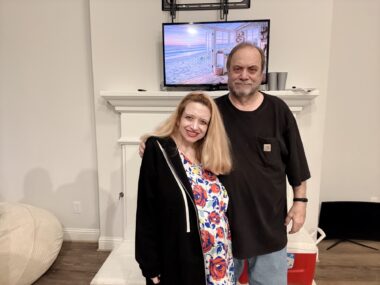
Rachel Nesmith spends time with her dad, David Nesmith, on Mother’s Day 2026. (Courtesy of Rachel Nesmith)
“What do you wish you had known about narcolepsy back then?” I asked.
“The signs and symptoms to look for, the diagnosis process, and how to prevent cataplexy falls,” he said.
I continued: “What has been the most difficult part for you to understand?”
“The instantaneous falling asleep or the cataplexy,” he said.
My father has always cared for me. He said the hardest part of seeing me live with narcolepsy is knowing he won’t be here forever to assist with driving, travel, or finances. I am blessed to have my parents fighting for me when I need support.
“When you struggle to stay awake and want to push on, I just want to fix it. I’m a fixer. I have a high success rate,” he said. “This is something I can’t fix, and that bothers me.”
“Dad, do you remember the first time you saw me experience cataplexy?” I wondered.
“Yes!” he exclaimed. “The pomegranate incident. I was told that a person in cataplexy was asleep, but the mind was awake. I came up with a word that wasn’t used every day, and when you recovered, you said the word back.”
Serious fears from a parent’s perspective
Several of his questions came from confusion: Why his daughter? How do we fix narcolepsy?
“When you lose muscle control, my greatest concern is that you may injure yourself and end up in the emergency room,” he said. “I used to be afraid you would seriously hurt yourself, but when you’re on medication, you function well with a lot less cataplexy. I’m excited about the new orexin agonists on the horizon, so you can live a safer, healthier, and more productive life.”
“Yes, that’s so true, Dad! Hope is on the way! Have you ever worried about when I travel or work independently?”
“Yes, when you are miles away, your mom and I always worry you might fall or get sleepy in an unsafe situation. Remember when you fell and hit your head at Hypersomnia Foundation’s Beyond Sleepy Conference in June? However, you’re an adult, you’re strong, and I respect how you live your life.”
“Have you ever watched someone misunderstand my narcolepsy symptoms in public?” I asked.
“Yes, sometimes we have to tell people you have narcolepsy, and they typically understand. If someone ever judged you unfairly, I’d defend you in an instant,” he said.
Always Dad’s pride and joy
“Dad? What have you learned from watching me live with this disease?” I asked.
“That you always endure hardship and press on. The part of your journey that made me proudest is your narcolepsy advocacy. It will help others who are just learning they have it and can live a good life with support. Your advocacy, writing, and music all make me proud. Your greatest strength is your drive and ability to fight until the end, for yourself and others.”
Dad is the best! No one knows you quite as well or as completely as an understanding parent.
“Dad, what do you see in me that I can’t always see in myself?”
My father explained, “You have a mission. Most people with a chronic or rare disease do. I think you’re on the right track. When you speak of advocacy, songwriting, writing, or helping others, I see your mission, passion, and strength to survive. You’re like me: You battle daily and never give up. You’re a survivor.”
In closing, Dad described how he sees me, without the narcolepsy and cataplexy, as only a father could: “When I see you, I see someone strong who has endured daily life carrying a heavier load that would’ve made others quit. An advocate who has time for others and is a loving mother and wife. Someone who cares about others. I cannot think of any criticism or improvement. I’ve done my job well. I am proud of you.”
Note: Narcolepsy News is strictly a news and information website about the disease. It does not provide medical advice, diagnosis, or treatment. This content is not intended to be a substitute for professional medical advice, diagnosis, or treatment. Always seek the advice of your physician or another qualified health provider with any questions you may have regarding a medical condition. Never disregard professional medical advice or delay in seeking it because of something you have read on this website. The opinions expressed in this column are not those of Narcolepsy News or its parent company, Bionews, and are intended to spark discussion about issues pertaining to narcolepsy.



Leave a comment
Fill in the required fields to post. Your email address will not be published.