
Sleep and wake patterns may help distinguish narcolepsy types
Small study found several measures held up across repeated testing
Written by |
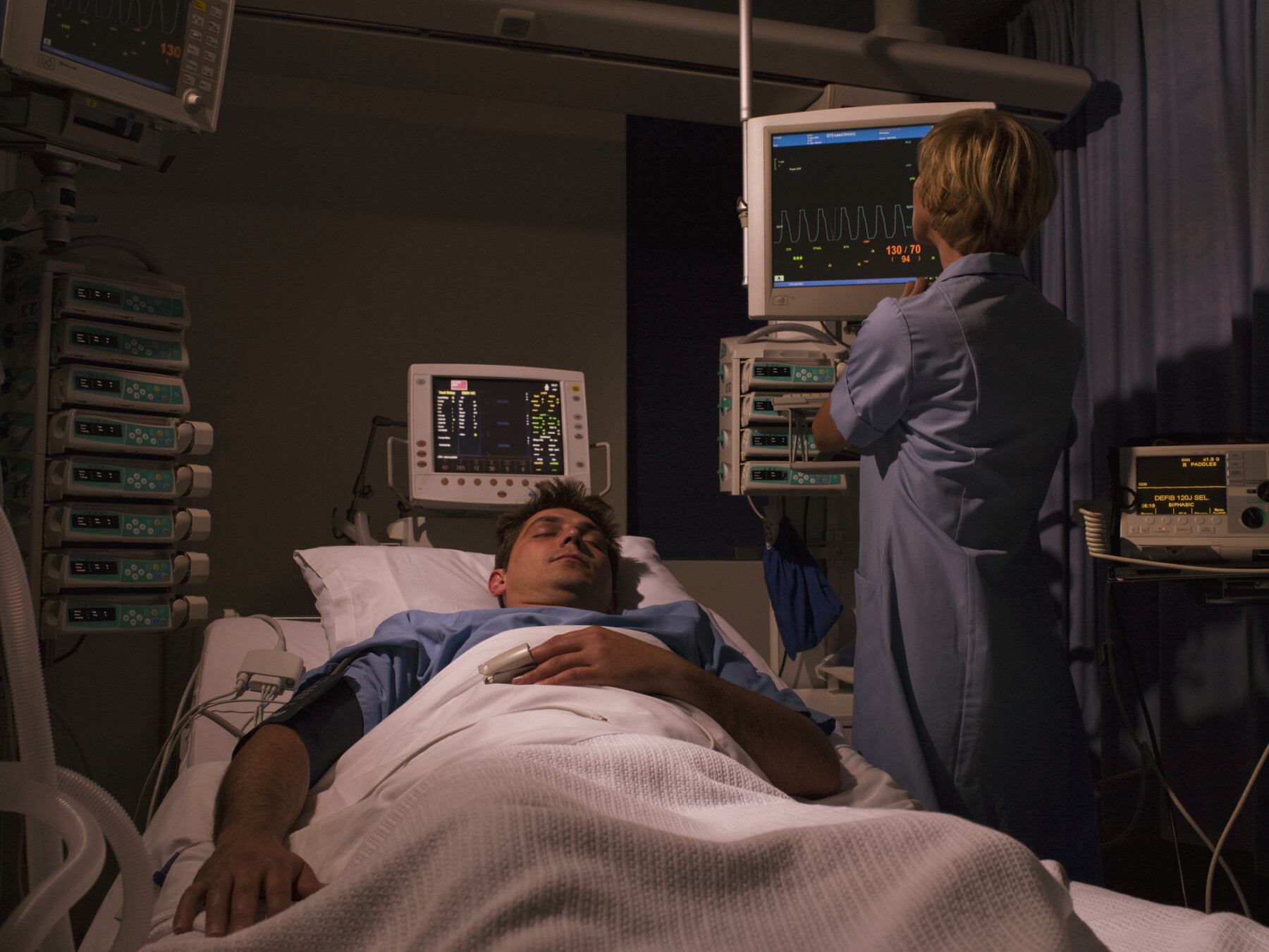
A patient undergoes an overnight sleep study while a healthcare professional monitors the results. Sleep studies measure brain activity and other body functions during sleep. (Photo from iStock)
Daytime wakefulness and certain patterns of nighttime sleep fragmentation may help distinguish adults with narcolepsy type 1 (NT1) from those with type 2 (NT2), according to an analysis of participants who were not taking narcolepsy medications while enrolled in one of two eight-week clinical trials.
People with NT2 showed more variable results from visit to visit in both overnight sleep studies and daytime wakefulness tests than those with NT1.

Study examines reliability of repeated sleep testing
“This study addresses an important gap by characterizing visit-to-visit reliability of sleep and wakefulness endpoints in narcolepsy type 1 (NT1) and type 2 (NT2),” the team wrote. “Improved reliability estimates should aid in clinical interpretation and differential diagnosis, as well as informing the design of future interventional studies.”
The study, “Nocturnal Features and Daytime Characteristics in Narcolepsy: Reliability and Diagnostic Relevance for NT1 vs NT2,” was published in Sleep.
Narcolepsy is a sleep disorder marked by excessive daytime sleepiness, as well as other sleep-related, cognitive, and mood symptoms.
NT1 is typically associated with cataplexy, a sudden loss of muscle tone triggered by strong emotions. This form is caused by the loss of brain cells that produce orexin, a chemical that normally helps regulate wakefulness. NT2 does not involve cataplexy. Its underlying cause is less well understood, and most people with NT2 have normal orexin levels.
Diagnosing narcolepsy requires a combination of clinical evaluation and specialized sleep laboratory testing. This includes an overnight sleep study, called polysomnography, which tracks how a person cycles through sleep stages, followed by a Multiple Sleep Latency Test (MSLT), which measures how quickly a person falls asleep during scheduled daytime naps.
Researchers in France and the U.S. sought to understand how consistent various sleep measurements are when repeated in the same person over time and whether any of them may help distinguish NT1 from NT2.
This question is especially relevant in clinical trials because researchers need to know whether a change in a measurement after treatment reflects a real drug effect or normal variation within the same person.
The team analyzed data from 17 people with NT1 and 19 with NT2 who received placebo in one of two Phase 2 clinical trials (NCT05687903, NCT05687916) testing Takeda Pharmaceuticals’ oveporexton. Participants visited the clinic three times, four weeks apart. Each visit included an overnight sleep study followed the next day by a Maintenance of Wakefulness Test (MWT), which measures a person’s ability to remain awake. To validate their findings, a separate group of 11 people with NT1 from an earlier clinical trial (NCT04096560) was examined.
Brainwave measures prove most consistent across visits
Of the 440 sleep-related measurements studied, 106 showed “good” reliability, defined as a reliability score above 0.75.
Brainwave-based measurements, especially quantitative EEG (qEEG) measures of brainwave activity and brief bursts of brain activity during sleep called sleep spindles, were the most consistent from visit to visit. Of the 120 qEEG features, nearly all (92%) had moderate or good reliability, meaning scores of 0.5 or higher, and just over half (52%) had good reliability, with scores above 0.75.
Many qEEG measurements taken during rapid eye movement (REM) sleep, the stage commonly associated with vivid dreaming, were especially stable. Even so, these highly reliable brainwave measurements showed little ability to distinguish NT1 from NT2.
In contrast, measurements describing the overall structure of sleep, called sleep architecture, such as the percentage of sleep spent in the lightest stage of sleep (N1), were less consistent from night to night but differed meaningfully between NT1 and NT2.
The authors noted that two of 37 hypnogram features, which describe sleep-stage patterns, and 23 of 248 hypnodensity features, which reflect the likelihood of a mixture of sleep stages at a given time, reached “good” reliability, “suggesting that within this population sleep architecture is highly variable from night to night.”
The researchers identified 40 features that had moderate or higher reliability and distinguished NT1 from NT2 across all three groups. Wake after sleep onset, the amount of time spent awake after initially falling asleep, and the percentage of time spent in N1 sleep were higher in NT1 than in NT2. The percentage and average length of time spent in N2 sleep were lower in NT1.
Specific hypnodensity measures reflecting a mixture of wakefulness and REM sleep showed good reliability (0.83) and were higher in NT1. These features are “not yet used clinically” but “may offer diagnostic value,” the team noted.
Daytime wakefulness testing differs by narcolepsy type
Data from the MWT showed good reliability in NT1 but were less consistent in NT2. Specifically, reliability was high in NT1 at 2 p.m. and 4 p.m. (0.89 and 0.87), but not at 10 a.m. or noon. Results also differed between NT1 and NT2 at the two later testing times. The 4 p.m. session was described as the most stable testing time for NT1.
Because participants received placebo and were not taking narcolepsy medications during the trials, the researchers also checked whether measurements changed across the three visits. Such changes could reflect a placebo response or changes associated with being off treatment.
In NT1, there were no significant changes in MWT results or overall sleep architecture across visits. In NT2, several changes were observed, including more total sleep time, less time awake, and more time in deep sleep (N3) and REM sleep.
The authors described these NT2 changes as “consistent with a first-night effect,” in which sleep during an initial laboratory visit may differ from sleep during later visits as participants become more familiar with the testing environment.
“We showed that spectral features (spindles, qEEG) had the best reliability but rarely differed between NT1 and NT2,” the team concluded. “In contrast, sleep onset latency from MWT and selected hypnodensity features had good reliability and differed by diagnosis.”




Leave a comment
Fill in the required fields to post. Your email address will not be published.