
Overcoming my fear after a narcolepsy diagnosis to start dating again
Dating with narcolepsy presents challenges most people never have to consider
Written by |

After my divorce in 2010, I wasn’t sure I would ever risk dating again. When my first marriage ended, I was carrying more than heartbreak. I was also living with narcolepsy with cataplexy, a condition that had already changed parts of my life that many people take for granted. Dating felt difficult enough on its own, but doing so while managing excessive daytime sleepiness and sudden muscle weakness felt nearly impossible.
I knew what many people pictured when they heard the word “narcolepsy”: someone who was always asleep or unable to live independently. Few understood what it meant to build a life around unpredictable symptoms, carefully crafted schedules, medication routines, and constant attention to safety.
The thought of putting myself out there again was terrifying. Still, I didn’t want fear to make my decisions for me.
Like many people starting over after a divorce, I eventually turned to online dating. One day, while browsing profiles on a dating website, I received a message from a man named Kerry. His opening line immediately caught my attention.
Rather than starting with a simple hello, he boldly joked that we were wasting valuable time being apart and suggested that we should raise a dog together. It was funny, unexpected, and confident. Most importantly, it made me smile. As we exchanged messages, I discovered he was intelligent, kind, and easy to talk to. Before long, we decided to meet in person.

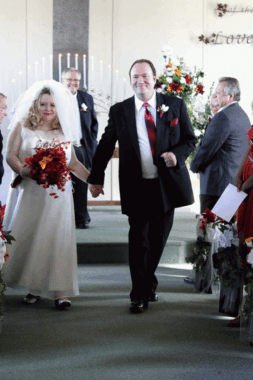
Rachel Nesmith and Kerry Harrison march down the aisle at their wedding in October 2013. (Courtesy of Rachel Nesmith)
Our first date felt magical from the moment it began. He picked me up in his 2009 navy blue Ford F-150, the same model of truck as my dad’s. We drove to a Texas Roadhouse restaurant, and the conversation flowed so naturally it felt like we had squeezed three dates into a single evening.
We talked about everything from family and life goals to our favorite television shows. We bonded over our mutual love of the television series “True Blood” and discovered that we both have a deep appreciation for 1990s rock music. Neither of us noticed that hours had gone by.
By the end of the night, I felt something I hadn’t felt in a very long time: hope.
But as wonderful as dating can be, dating with narcolepsy and cataplexy presents unique challenges that most people never have to consider.
For me, every outing required planning. Because cataplexy made it unsafe for me to drive, transportation had to be arranged ahead of time. I also had to consider my energy, symptoms, medication schedule, and whether I would be safe if I had a sleep attack or cataplexy episode away from home. Dating requires vulnerability in any situation. But dating with narcolepsy requires even more.
I had to trust that someone wouldn’t judge me for my condition. I had to trust that if symptoms appeared, I wouldn’t be abandoned or made to feel like a burden.
‘Breathing is sexy’
For a while, things seemed to be going well. Then, about a month into our relationship, my phone rang while I was shopping at a dollar store. It was Kerry. His voice was serious. He told me he thought we should break up. I remember feeling completely blindsided.
Explaining why, he said my narcolepsy was a deal-breaker. In that moment, disappointment and frustration washed over me — not because I was ashamed of my condition, but because I was tired of being defined by it.
This was someone who had already gotten to know me. He had seen me laugh, and he had seen me cry. We’d spent hours talking about our dreams, our families, and our futures.
How could a diagnosis suddenly outweigh all of that? Without missing a beat, I responded. “What? I am everything you ever wanted in a woman. I just happen to have narcolepsy with cataplexy.”
Then I said something I still believe today. “And you know what? It makes me stronger because I face these challenges every single day.” Silence enveloped the other end of the phone. For a moment, I wondered whether I had said too much.
Then Kerry finally spoke. “Well,” he said slowly, “I guess it’s not that bad.” Then he told me he had his own health challenge with sleep apnea. He was supposed to use a CPAP machine, but someone had made him feel embarrassed about it and told him it wasn’t attractive. He was worried I might feel the same way. I couldn’t help but laugh. “Breathing is sexy,” I told him.
Then I repeated it. “Breathing is sexy.” The tension immediately disappeared.
Looking back, I think that conversation changed everything. For the first time, we both stopped worrying about appearing perfect. We stopped focusing on our medical conditions and started seeing each other as two people navigating life’s challenges together.
Nobody gets through life without baggage. Some baggage is visible, and some isn’t. What matters is finding someone willing to help carry it. After that conversation, our relationship continued to grow stronger.
Instead of allowing narcolepsy to become a barrier, we learned how to work around it together. Kerry learned about my symptoms, understood my limitations, and accepted that some days would be harder than others. More importantly, he never made me feel less worthy because of them.
On Valentine’s Day 2013, Kerry and I took a romantic trip to Port Aransas, Texas. Upon arrival, he excitedly proposed to me with a huge smile on his face. That October we were married surrounded by family and friends.
Note: Narcolepsy News is strictly a news and information website about the disease. It does not provide medical advice, diagnosis, or treatment. This content is not intended to be a substitute for professional medical advice, diagnosis, or treatment. Always seek the advice of your physician or another qualified health provider with any questions you may have regarding a medical condition. Never disregard professional medical advice or delay in seeking it because of something you have read on this website. The opinions expressed in this column are not those of Narcolepsy News or its parent company, Bionews, and are intended to spark discussion about issues pertaining to narcolepsy.

Rachel Nesmith
How have your experiences been like dating with Narcolepsy?