
My greatest leap of faith was becoming a mom with narcolepsy
All my doubts vanished the moment I held my daughter for the first time
Written by |


On March 27, 2014, I was lying in a hospital bed preparing for my second liver resection to remove a rapidly growing hepatocellular adenoma. My family surrounded me as nurses completed the final preoperative checks. Then one simple question changed the course of my life.
“Is there any possibility you could be pregnant?”
Within minutes, my surgery was canceled. I was five weeks pregnant.

Searching for and attaining prenatal care
At the time, I was already living with narcolepsy with cataplexy and type 2 diabetes while carrying a large liver tumor that required surgical removal. Pregnancy instantly transformed an already complicated medical situation into an extremely high-risk one.
Finding an obstetrician willing to manage my care wasn’t easy. Fortunately, I eventually found a physician who believed in me and was willing to coordinate with my liver surgeon and other specialists. Every month, I underwent liver ultrasounds to ensure my hepatocellular adenoma wasn’t growing dangerously. Every week, I visited my obstetrician to carefully monitor my diabetes, adjust my insulin, and manage my nutrition.
Every appointment carried both hope and uncertainty. Battling self and outside doubt, I constantly wondered if my body could safely carry my daughter to term.
Just as overwhelming were the questions about motherhood. How could I safely care for a newborn when I couldn’t drive because of cataplexy? What if I experienced a sleep attack while holding my baby? Would overwhelming daytime sleepiness prevent me from giving my daughter the childhood she deserved?
Narcolepsy forced me to become a strong mom
On Nov. 3, 2014, my daughter, Savannah, was born by cesarean section at 37 weeks. The moment I held her, every doubt disappeared.
I didn’t wonder whether I could be a good mother anymore. I already was. Pregnancy had required tremendous courage. Every day, I balanced narcolepsy, cataplexy, diabetes, and a growing liver tumor while trusting that my daughter and I would somehow make it safely to delivery.
Motherhood introduced a completely different challenge. People often say, “Sleep when the baby sleeps.” For someone living with narcolepsy, that’s much easier said than done.
The sleep deprivation of caring for a newborn dramatically worsened my excessive daytime sleepiness. I quickly realized that my daughter’s safety depended on keeping my narcolepsy well controlled.
After discussing my options with my physicians, I chose formula feeding so I could safely resume medications that helped control my narcolepsy and cataplexy. Remaining awake while feeding, carrying, and caring for Savannah was my highest priority.
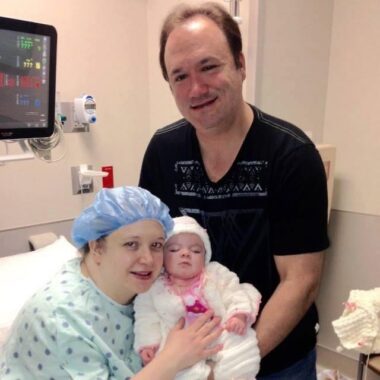
Rachel Nesmith sits in a hospital bed beside her husband, Kerry Harrison, holding her 4-month-old, Savannah Harrison, right before her second liver resection. (Courtesy of Rachel Nesmith)
When Savannah was 4 months old, I finally underwent my postponed liver resection.
Four days after surgery, my parents gently laid Savannah beside me in my hospital bed. Seeing her filled me with overwhelming joy. That intense emotion immediately triggered status cataplecticus.
As my muscles collapsed, I slipped into sleep paralysis accompanied by a vivid hypnagogic hallucination. In my dream, I was inside a futuristic hospital where I accidentally dropped my baby into a vacuum transport system that hurled her to the floor. I was convinced she had died. The terror felt completely real.
When I finally emerged from the episode, my parents were standing beside me holding Savannah. She had never fallen. She had been safe the entire time.
My narcolepsy symptoms had become much worse because I had been without my narcolepsy medications for several days following surgery. The relief I felt knowing my daughter was alive remains one of the most powerful emotions I have ever experienced.
An extraordinary kind of love
Today, Savannah is 11 years old. She is brilliantly imaginative, endlessly creative, loves animals and anime, and spends hours inventing elaborate role-playing adventures. She has since been diagnosed with attention-deficit/hyperactivity disorder and lower-support-needs autism spectrum disorder, creating new parenting challenges and opportunities to advocate for her. Just as I once advocated for my own medical care, I now advocate for hers.
Throughout the years, our family’s journey has looked different from what many people expected. My parents, my husband’s family, and my incredible husband, Kerry, have all stepped in to help care for Savannah whenever my health required extra support. Their love reminds me that asking for help is not weakness. It is wisdom.
Looking back, becoming a mother didn’t happen despite my chronic illnesses. It happened alongside them.
Narcolepsy with cataplexy has taught me empathy. Diabetes has taught me discipline. My liver disease taught me courage. Together, those experiences have made me a more patient, compassionate mother than I ever imagined possible.
Parenting a neurodivergent child while living with narcolepsy certainly isn’t easy. Some days are exhausting beyond words. But watching Savannah grow into a kind, intelligent, resilient young woman has made every obstacle worthwhile.
My illnesses never prevented me from becoming the mother she needed. They simply taught me how to love her in extraordinary ways.
If you’re living with narcolepsy or another chronic illness and wondering whether motherhood is possible, know this: Your diagnosis does not determine your capacity to love, nurture, or raise an incredible child. It may change your path, but it does not diminish your ability to become an extraordinary parent.
Note: Narcolepsy News is strictly a news and information website about the disease. It does not provide medical advice, diagnosis, or treatment. This content is not intended to be a substitute for professional medical advice, diagnosis, or treatment. Always seek the advice of your physician or another qualified health provider with any questions you may have regarding a medical condition. Never disregard professional medical advice or delay in seeking it because of something you have read on this website. The opinions expressed in this column are not those of Narcolepsy News or its parent company, Bionews, and are intended to spark discussion about issues pertaining to narcolepsy.



Leave a comment
Fill in the required fields to post. Your email address will not be published.