
The day I put the ‘sleep’ in the annual sleeping disorders conference
I learned a valuable lesson after narcolepsy reminded me who's in charge
Written by |


Imagine being the one person with narcolepsy who literally falls asleep on a chair, and then the floor, at a conference about hypersomnia.
And I’m not talking about quietly nodding off. I’m talking about nodding and hitting my head on the way to the ground, with the side of my face ending up on the carpet. If there were an award for embodying the conference theme, I might have won it that day.
Last week, I attended the Hypersomnia Foundation’s Beyond Sleepy Conference in Baltimore. It was exactly the kind of event I love, one filled with people who understand what it’s like to live with disorders that most of the world doesn’t fully comprehend. For once, I wasn’t surrounded by people who needed an explanation of excessive daytime sleepiness, sleep inertia, brain fog, or cataplexy. I was among my people, my Sleepy Peeps!
Yet despite being in a room full of sleep disorder experts, researchers, caregivers, and patients, my narcolepsy still managed to remind me who’s really in charge.
One moment, I was participating in the conference activities. The next, I found myself fighting the overwhelming pull of sleep that every person with narcolepsy knows so well. It wasn’t a matter of being bored or because I stayed up too late, nor was it a lack of interest. It was narcolepsy doing what narcolepsy does.

Narcolepsy on public display
I tried to push through it, as most of us with narcolepsy do. We become experts at negotiating with our brains: “Just stay awake another five minutes.” “Just make it to the next session.” “Just get through this conversation.”
Sometimes those negotiations work, and sometimes they don’t. This was one of those times when it didn’t. Eventually, my body made the decision for me.
Looking back, the entire situation feels almost comical. Out of all the places in the world to unexpectedly collapse into sleep, it happened at a conference specifically designed for people whose lives are shaped by sleep disorders. Only in our community would that be completely understandable.
In most settings, a chair sleep-attack nap resulting in me falling to the floor would attract stares, judgment, or confusion. People might assume I was intoxicated, lazy, rude, or ill. They would likely have questions. At Beyond Sleepy, nobody seemed shocked. I was transferred to a stretcher and taken by ambulance to the University of Maryland’s emergency room, where a CT scan revealed no concussion, but evidence I’d survived a stroke in the past and have developed a nodule on my thyroid.
Getting answers and asking more questions
As people with narcolepsy, we are typically great communicators, providing each other a safe space for coping through sleepy eyes. In fact, many people understood exactly what had happened because they had experienced something similar themselves. That realization was powerful.
Living with narcolepsy often means carrying invisible struggles through highly visible situations. The public sees us yawn. They see us close our eyes. They see us sit down unexpectedly or leave early. What they don’t see is the exhausting battle happening inside. They don’t see the constant calculations: “Can I drive safely?” “Will I stay awake through this meeting?” “Do I have enough energy for this event?” “What happens if cataplexy strikes? Will people understand?”
For many of us, every outing comes with contingency plans. The Beyond Sleepy Conference reminded me that those calculations are shared by thousands of others, although the details may differ. Some attendees live with idiopathic hypersomnia. Others have narcolepsy. Some are caregivers or parents. But everyone understood that sleep disorders don’t disappear simply because we’re determined, motivated, or excited to be somewhere.
Lessons learned
Sometimes we can be having the time of our lives and still fall asleep. That reality can be frustrating, but it can also be strangely liberating when you’re surrounded by people who understand. No apologies or lengthy explanations are required. There’s no pretending you’re fine when you’re not. There’s just understanding.
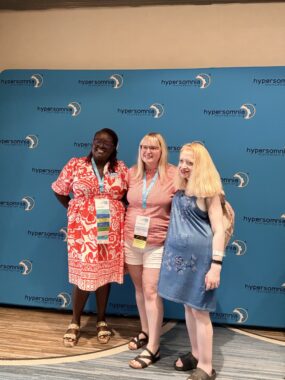
People who get it: From left, Kerly Bwoga, Tara O’Connor, and Rachel Nesmith pose for a photo at the 2026 Hypersomnia Foundation’s Beyond Sleepy Conference in Baltimore. (Courtesy of Rachel Nesmith)
Years after my diagnosis, I still have moments when I wish determination could override biology. But Baltimore reminded me of something more important: Acceptance is not giving up.
Thankfully, I was surrounded by people I love, and I’m incredibly grateful for everyone who stepped up to ensure that my health was the most important concern. I’m grateful to the Hypersomnia Foundation’s employees, speakers, and volunteers. I’m thankful for the Wellness, Sleep and Circadian Network staff and my sleep doctor, Anne Marie Morse, who looked after me after I hit my head.
That’s the lesson I carried home: The most meaningful thing we can offer one another isn’t advice or solutions. It’s understanding. Seeing someone’s reality and accepting it without judgment can be more powerful than we realize. For people living with narcolepsy and other hypersomnia disorders, that kind of acceptance can feel every bit as restorative as sleep itself.
Note: Narcolepsy News is strictly a news and information website about the disease. It does not provide medical advice, diagnosis, or treatment. This content is not intended to be a substitute for professional medical advice, diagnosis, or treatment. Always seek the advice of your physician or another qualified health provider with any questions you may have regarding a medical condition. Never disregard professional medical advice or delay in seeking it because of something you have read on this website. The opinions expressed in this column are not those of Narcolepsy News or its parent company, Bionews, and are intended to spark discussion about issues pertaining to narcolepsy.

Leave a comment
Fill in the required fields to post. Your email address will not be published.