
14 people with narcolepsy share their best advice for the newly diagnosed
Diagnosed with narcolepsy just over a year ago, our community manager @emmis.studio asked Narcolepsy News Instagram followers and Narcolepsy News Forum members a simple question:

“What advice do you have for people newly diagnosed with narcolepsy?”

The replies came in from people living with narcolepsy for one year to 25 years, from South Africa to the school pickup line, from a teenager negotiating classroom accommodations to a parent learning to sleep when the baby sleeps.

Here is what they said, in their own words.

Before you scroll: Everything below is lived experience shared by members of the narcolepsy community, not medical guidance. Narcolepsy varies widely from person to person in subtype, symptoms, and what actually helps. Talk with your sleep specialist before changing medications, doses, or routines.


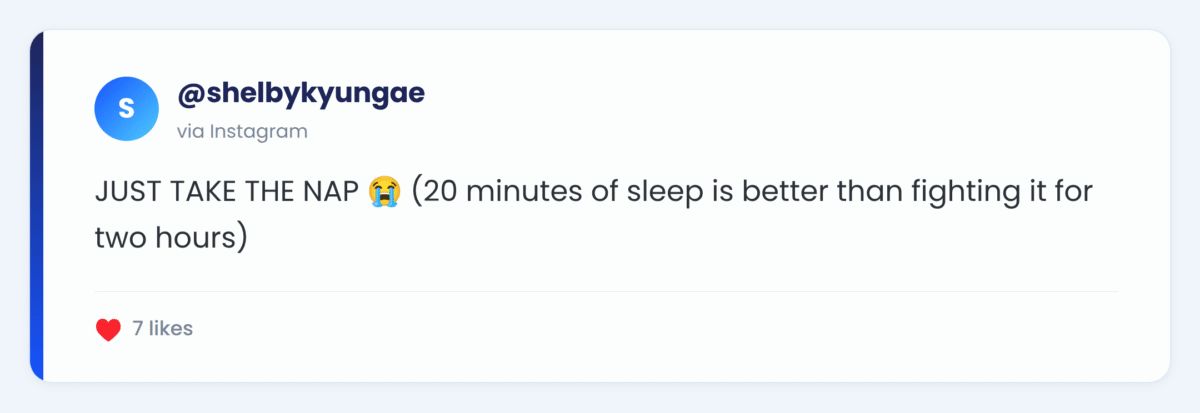
1. Just take the nap. Seriously. Take it.
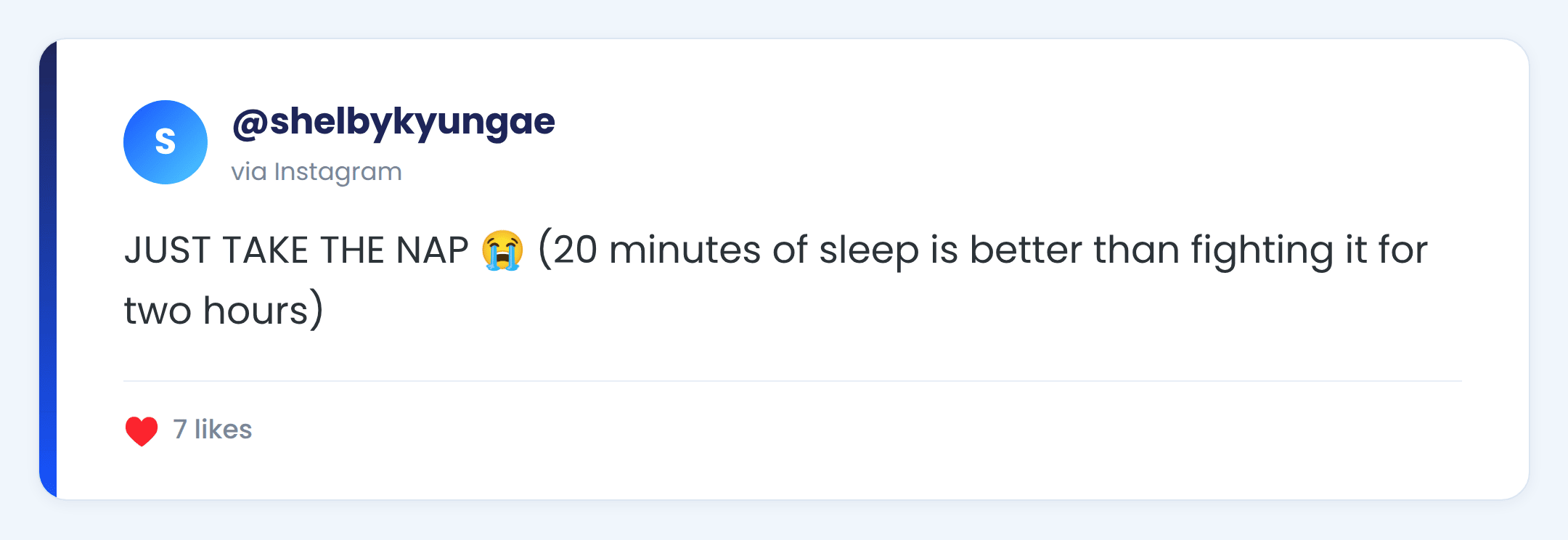
Instagram comment from @shelbykyungae: JUST TAKE THE NAP 😭 (20 minutes of sleep is better than fighting it for two hours)

The most-repeated piece of advice in the thread — and the shortest. The math here is simple: 20 minutes surrendered beats two hours of white-knuckling through the fog every single time.


2. Give yourself grace.
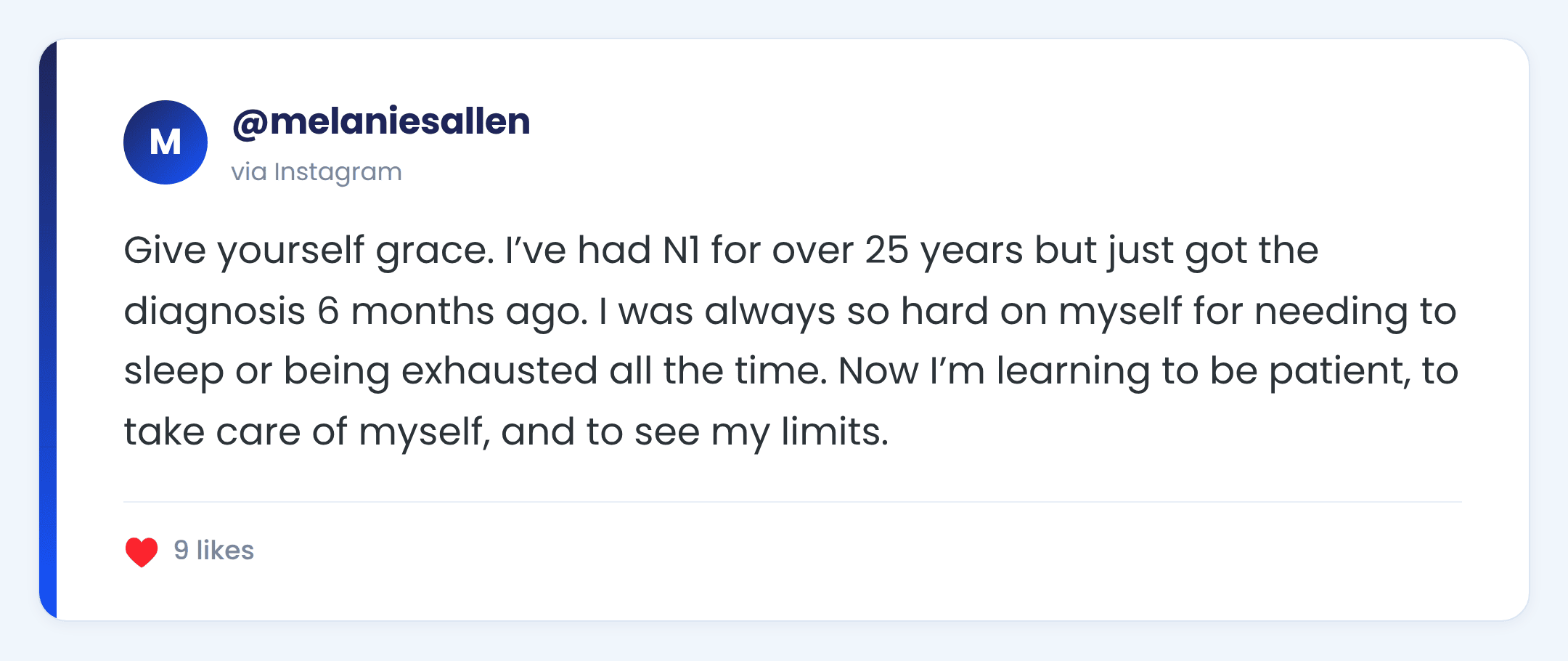
Instagram comment from @melaniesallen: Give yourself grace. I’ve had N1 for over 25 years but just got the diagnosis 6 months ago. I was always so hard on myself for needing to sleep or being exhausted all the time. Now I’m learning to be patient, to take care of myself, and to see my limits.

Twenty-five years of symptoms, six months of having an official name for them. Several people described this exact same delayed arrival, and the crucial first task that comes after: forgiving the version of themselves who thought they were “just lazy.”


3. Build a routine. Then let yourself break it sometimes.

Instagram comment from @chelssayens: Routine is key. I always make sure to go to bed and that same time everyday it’s ok to have days where you don’t but make it habit to aim for that. It helps train your brain more. Also with medication don’t be afraid to change it if it doesn’t work it doesn’t work. Try to stick to scheduled naps. It’s hard trust me but when you feel overcome with having to take a nap try to change your environment something simple as washing your hands with cold water can help or walking.

Notice how sleep-hygiene advice usually leaves out the part about actually sticking to scheduled naps? Consistency is the ultimate goal here, not a rigid test you fail. Changing up your environment (like a cold-water splash) beats fighting your own body every day of the week.


4. Treat your senses like tools.
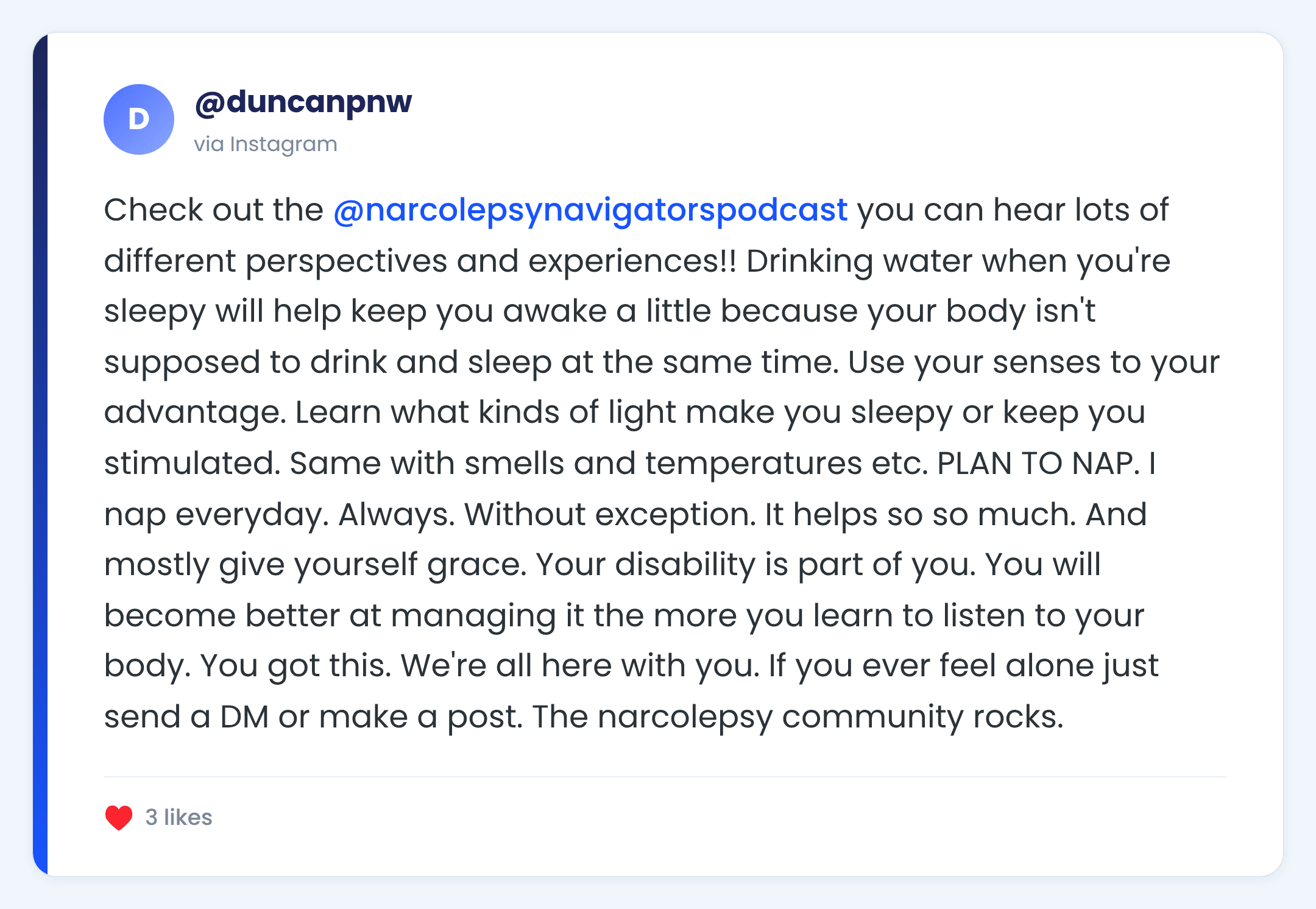
Instagram comment from @duncanpnw: Check out the @narcolepsynavigatorspodcast you can hear lots of different perspectives and experiences!! Drinking water when you're sleepy will help keep you awake a little because your body isn't supposed to drink and sleep at the same time. Use your senses to your advantage. Learn what kinds of light make you sleepy or keep you stimulated. Same with smells and temperatures etc. PLAN TO NAP. I nap everyday. Always. Without exception. It helps so so much. And mostly give yourself grace. Your disability is part of you. You will become better at managing it the more you learn to listen to your body. You got this. We're all here with you. If you ever feel alone just send a DM or make a post. The narcolepsy community rocks.

Light, temperature, smell, and an ice-cold glass of water. Think of this as your personal field manual. The real takeaway? You get remarkably good at navigating this condition the moment you learn to listen more to what your body is asking for.


5. If you’re yawning behind the wheel, pull over.

Instagram comment from @redviola_02: After having more experience of driving, I suggest pull over if you find yourself yawning a LOT (every couple seconds) while driving. Don’t try to tough it out! Bring sunglasses with you always into the car! If you feel drowsy as you are about to leave an area, put on your sunglasses and get some shuteye in your car. The sunglasses are so people don’t notice you’re asleep and usually the naps are about 5 to 20 mins.

This is the most practical safety advice in the entire thread. Drowsy driving is one of the very real dangers of untreated or undertreated narcolepsy. “Toughing it out” is never the right answer — pulling over is.


6. Control what you can control.

Instagram comment from @bronte_hall: I’ve been diagnosed for nearly 10 years, have had symptoms for 15, When I was first diagnosed I used social media a lot to find other people with narcolepsy, probably the biggest thing I have found is Exercise and balanced diet, high protein and reduce processed food as much as possible. Even if it is just getting out for a walk, helps so much with alertness for hours afterwards. Control what you can control. Taking a nap can help with a little refesh and maybe give you the ability to take less medication, in my case it does, but everyone is different. Another thing is we can’t expect people to understand how we feel, I used to get frustrated when people complained about being tired when I was living with a next level of exhaustion but unless they are experiencing it they don’t get it, although it is nice when people make an effort to understand I think that has to be enough. Finally never feel bad for cancelling plans or saying NO, you know your limits, don’t feel bad for looking after yourself. 💗

This list strikes the perfect balance between practical habits (walking, protein, cutting down on processed food) and emotional boundary-setting. The line readers kept quoting back: Never feel bad for saying no.


7. Ask for school accommodations. All of them.
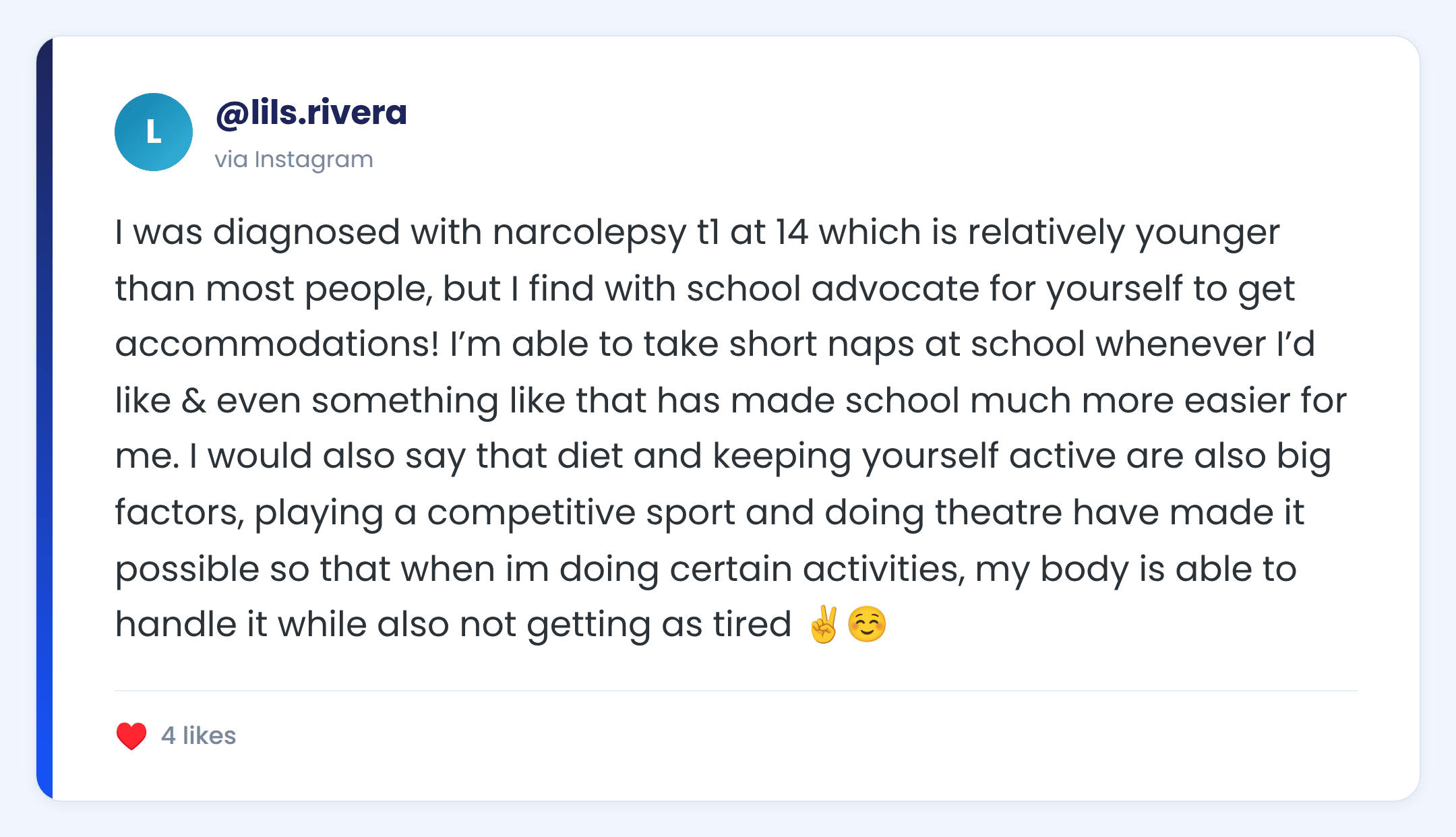
Instagram comment from @lils.rivera: I was diagnosed with narcolepsy t1 at 14 which is relatively younger than most people, but I find with school advocate for yourself to get accommodations! I’m able to take short naps at school whenever I’d like & even something like that has made school much more easier for me. I would also say that diet and keeping yourself active are also big factors, playing a competitive sport and doing theatre have made it possible so that when im doing certain activities, my body is able to handle it while also not getting as tired ✌️☺️

Diagnosed with narcolepsy at 14, Lilly is already better at self-advocacy than most adults. Getting permission to take planned naps at school transformed her experience, and she still competes in sports and does theater.


8. Look for flexibility at work and grace at home.

Instagram comment from @capoat: Get a wfh job with flexibility, where you can take a nap and then get back to work. Join a Narcolepsy community such as fb support groups, as they will help with tricks and tips. If you become a mom, literally sleep when the baby sleeps. Who cares about chores, you are in survival mode. Have a supportive partner to help you when your energy level days are at a 1 and they may be at a 6. Some days one partner carries more than the other and other days you do. Force yourself to do some sort of exercise such as a walk around the block. It helps and the more you keep at it, the better. Reduce sugar it can make symptoms worse. If on medication, don't skip doses. An app like Medisafe with notifications turned on will help. It is honestly all trial and error and depends on what type of Narcolepsy you have as well. I have Narcolepsy without cataplexy. I haven't been on Narcolepsy meds since I had my baby (he's 4 now), but I want another one. Some days life feels like I'm excelling, some days it is hard. Also, for women who are narcolepric, keep in mind different times of your cycle can make your symptoms worse. I also wfh. My medicine atm is naps, exercise, fresh air, and surviving 😂.

The longest answer in the thread, and easily the most comprehensive: remote work, support groups, medication alarms, a partner who steps up on the hardest days, and a key observation about how symptoms shift across the menstrual cycle (something patients talk about far more often than doctors do).


9. If you don’t have answers yet, the internet might.
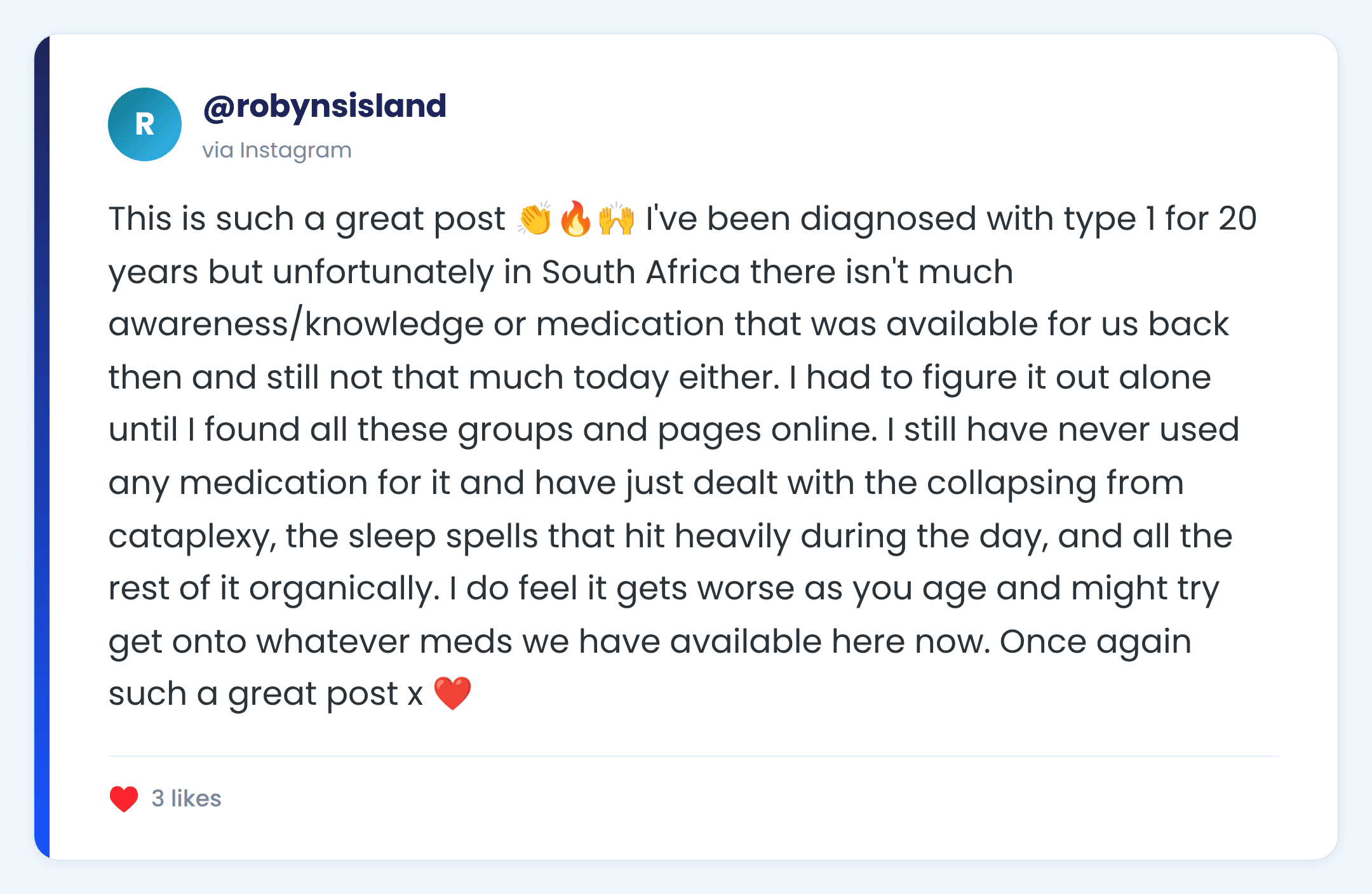
Instagram comment from @robynsisland: This is such a great post 👏🔥🙌 I've been diagnosed with type 1 for 20 years but unfortunately in South Africa there isn't much awareness/knowledge or medication that was available for us back then and still not that much today either. I had to figure it out alone until I found all these groups and pages online. I still have never used any medication for it and have just dealt with the collapsing from cataplexy, the sleep spells that hit heavily during the day, and all the rest of it organically. I do feel it gets worse as you age and might try get onto whatever meds we have available here now. Once again such a great post x ❤️

Twenty years with type 1 narcolepsy in South Africa, managing cataplexy and sleep attacks with limited access to local treatment. Her lifeline turned out to be online support groups. When the healthcare system falls short, the community becomes the infrastructure.


10. Expect to meet a new version of yourself.

Instagram comment from @mandafunari: My brain feels like I’ve woken up in another dimension. After spending almost 20 years asleep, I really think my narcolepsy started super early at age 9/10, I realized I knew myself, but I didn’t really know myself after the diagnosis. So, I’m lucky to have such supportive family and friends that understand each phase of this journey, but it’s nice to be fully back and be healthy and happy!

“My brain feels like I’ve woken up in another dimension.” Few people warn you about the subtle identity shifts that happen when you learn to navigate life with a chronic condition.


11. Find an advocacy group.
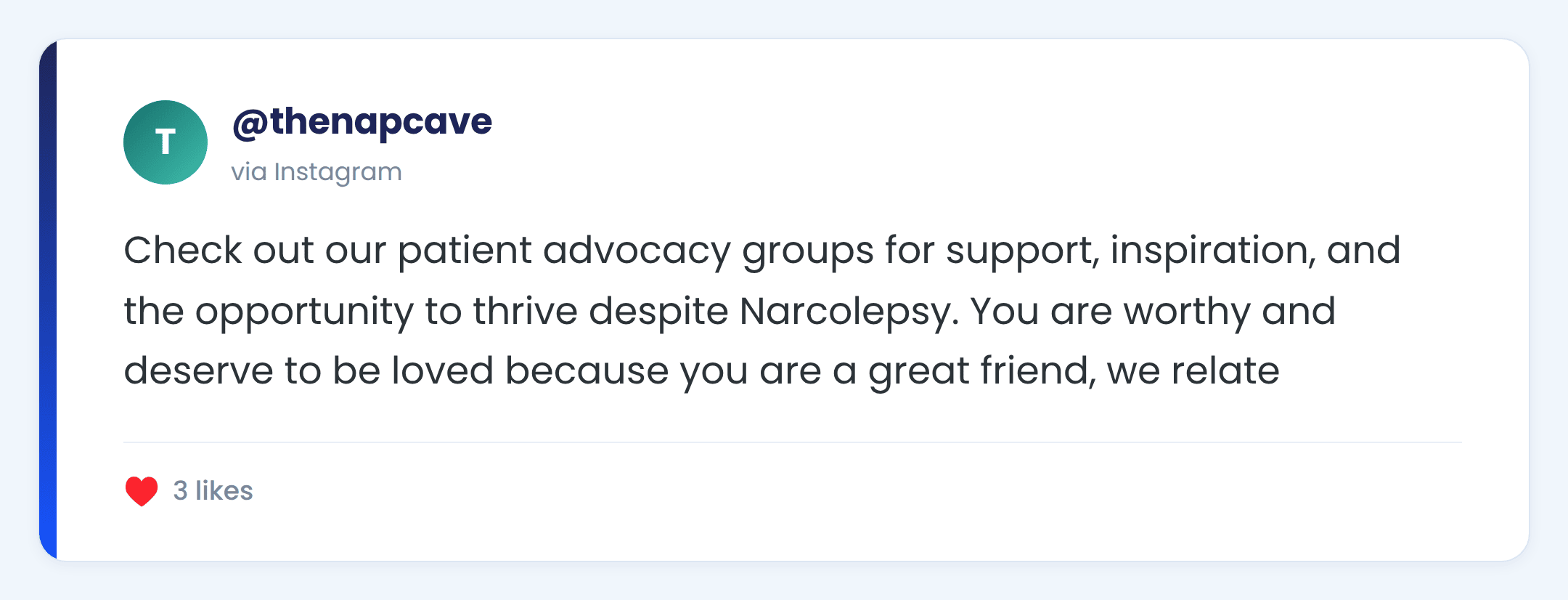
Instagram comment from @thenapcave: Check out our patient advocacy groups for support, inspiration, and the opportunity to thrive despite Narcolepsy. You are worthy and deserve to be loved because you are a great friend, we relate

Short, sweet, and functions as the underlying thesis of this entire list.


12. There’s a group chat. Join the group chat.

Instagram comment from @narcolepsynavigatorspodcast: So Naps for Life has a WhatsApp group that you can join and talk to other people, and we also have a Facebook group .

WhatsApp and Facebook groups came up again and again. If isolation feels like the heaviest part of this diagnosis — and for a lot of people, it really is — joining a chat is the lowest-effort, highest-reward fix on the board.


13. Go slow when you are titrating something new.
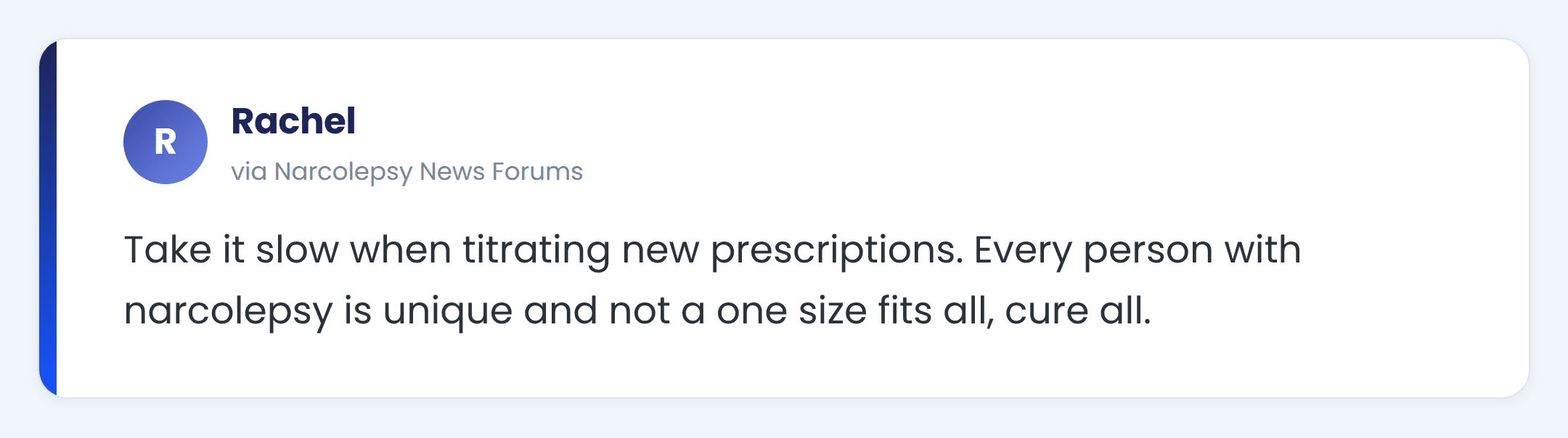
Narcolepsy News forums comment from Rachel: Take it slow when titrating new prescriptions. Every person with narcolepsy is unique and not a one size fits all, cure all.

Finding a medication that works is rarely a straight line. It’s a process of trial and adjustment. What works wonders for one person with narcolepsy might do nothing for the next.


14. Write it down before you get to the appointment.
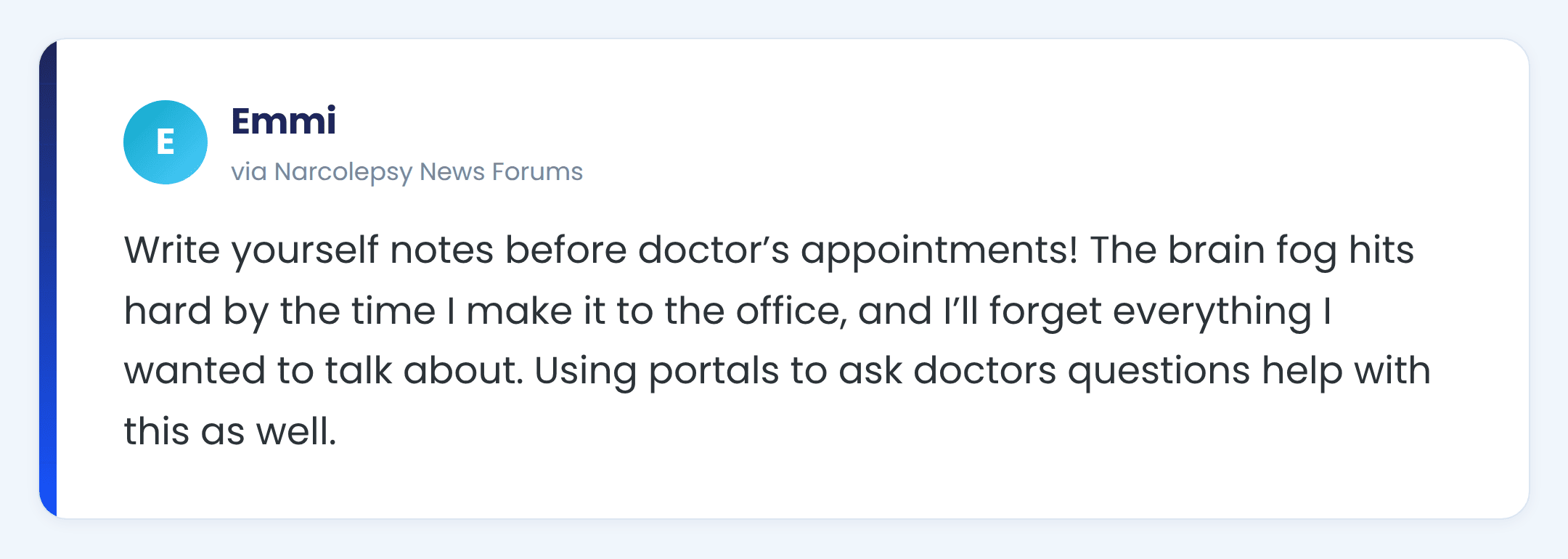
Narcolepsy News forums comment from Emmi: Write yourself notes before doctor’s appointments! The brain fog hits hard by the time I make it to the office, and I’ll forget everything I wanted to talk about. Using portals to ask doctors questions help with this as well.

Emmi rounded out the thread with her own tip: Brain fog and a short appointment slot are a terrible combination. Write your notes ahead of time and use your patient portal to ask any questions that only come to you on the drive home.


The thread behind the thread

Read all 15 answers end to end, and a clear pattern emerges: almost nobody’s advice is actually about narcolepsy itself.

It’s mostly about permission.

Permission to nap, to cancel plans, to ask for accommodations, to stop explaining yourself, and to finally stop treating your own physiological limits as a character flaw.

What would you add? Join the conversation in the Narcolepsy News Forums or on our Instagram.


Narcolepsy News is strictly a news and information website about the disease. It does not provide medical advice, diagnosis, or treatment. This content is not intended to be a substitute for professional medical advice, diagnosis, or treatment. Always seek the advice of your physician or other qualified health provider with any questions you may have regarding a medical condition. Never disregard professional medical advice or delay in seeking it because of something you have read on this website.

FAQs about narcolepsy advice for the newly diagnosed